
Early Enteral Nutrition After Pancreatoduodenectomy in NUTRIWHI
Key Takeaways
- Early supplemental enteral nutrition was associated with a lower 90-day comprehensive complication index after pancreatoduodenectomy in patients with an NRS score of 3 or higher.
- Overall 90-day morbidity was not statistically different, while infectious and pulmonary complications were lower in the enteral nutrition group.
- Nasojejunal feeding was generally workable, though tube removals required replacement and some patients continued enteral nutrition after discharge.
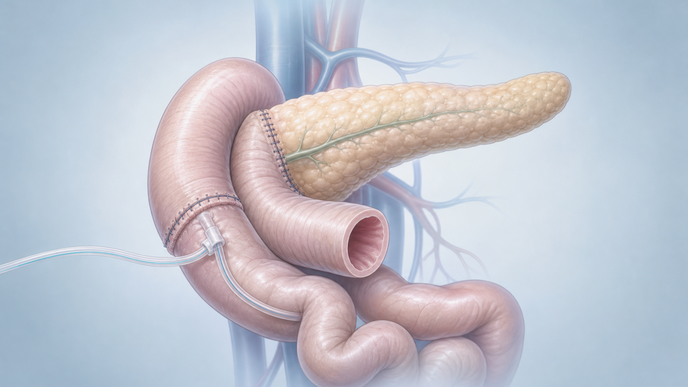
The NUTRIWHI randomized clinical trial was a parallel, open-label, superiority trial at 3 tertiary centers in Switzerland and France. Eligible patients were undergoing pancreatoduodenectomy and had a preoperative nutritional risk screening score of at least 3. Of 144 included patients, 142 were randomized, and 118 were analyzed after 24 dropouts, leaving 59 patients in each group. Enteral feeding started immediately after surgery through an intraoperatively placed nasojejunal tube alongside oral intake, while the comparator group received oral nutrition alone during hospitalization; standardized parenteral nutrition use was allowed in both groups. All patients followed a pancreatoduodenectomy-specific ERAS pathway, and postoperative parenteral nutrition was required in 30 enteral-group patients and 32 oral-group patients. Both groups otherwise followed the same postoperative pathway.
The primary outcome was mean comprehensive complication index at 90 days, which measured 25.5 with early enteral nutrition and 35.8 with oral nutrition. The mean difference was 10.3 points (oral minus enteral), with a 95% CI of 1.8 to 18.8 and P=.02. Overall 90-day morbidity was not significantly different, occurring in 45 of 59 versus 51 of 59 patients in the enteral and oral groups, with RR 1.13 for oral versus enteral, 95% CI 0.9 to 1.9, and P=.18. Infectious complications occurred in 12 of 59 versus 22 of 59 patients in the enteral and oral groups, with RR 1.83 for oral versus enteral and P=.04, while pulmonary complications occurred in 3 versus 11 patients, with RR 3.66 for oral versus enteral and P=.02. Major complications showed a near-significant pattern at 16 of 59 versus 26 of 59 in the enteral and oral groups, with RR 1.63 for oral versus enteral, 95% CI 1.0 to 2.7, and P=.06.
There was no between-group difference for delayed gastric emptying, pancreatic fistula, postoperative hemorrhage, or surgical site infection. Length of stay was 19 versus 17 days in the enteral and oral groups, with a median difference of -1.9 days for oral versus enteral, 95% CI -8.5 to 4.7, and P=.56. Ninety-day readmission occurred in 16 of 59 versus 13 of 59 patients in the enteral and oral groups, with RR 0.81 for oral versus enteral, 95% CI 0.4 to 1.5, and P=.52. Time to reach 50% of caloric requirements with oral nutrition was similar between groups.
In the enteral group, 14 involuntary nasojejunal tube removals required replacement. Three patients assigned to enteral nutrition did not receive it during hospitalization because of mechanical obstruction or failed tube insertion. Median enteral nutrition duration was 10 days, median postoperative day 3 flow rate was 30 mL/h, and 10 patients reported slight to moderate discomfort on postoperative day 3. Ten patients were discharged with enteral nutrition continuing at home. Subgroup analyses addressed older age, diabetes, BMI, preoperative biliary drainage, and NRS score greater than 3, but the authors described them as underpowered and vulnerable to multiple testing. The findings were limited to patients with NRS scores of 3 or higher, and blinding, sample size, and center imbalance constrained precision.