
EEG-Guided Dexmedetomidine-Ketamine Improves Lumbar Fusion Recovery
Key Takeaways
- Older adults undergoing elective lumbar spine fusion had a smaller 24-hour decline in QoR-15 with a dexmedetomidine-ketamine multimodal protocol plus EEG-guided titration than with conventional balanced anesthesia.
- The multimodal approach was associated with lower sevoflurane exposure, less intraoperative fentanyl, and less morphine use in the recovery unit.
- The tradeoff was greater intraoperative hemodynamic support, including more frequent atropine use.
- In exploratory 3-month analyses, average pain intensity was lower with the multimodal strategy, but the proportion of pain-free patients did not differ significantly between groups.
- Measured postoperative safety outcomes, including delirium, gastrointestinal recovery, neurocognitive trajectory, intensive care unit admission, and hospital stay, did not differ significantly between groups.
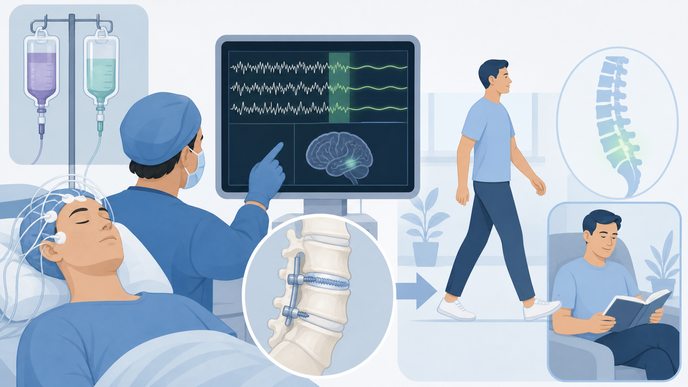
In a randomized trial conducted at a single center in Taiwan, 100 adults aged 60 years or older undergoing elective lumbar spine fusion were randomized 1:1, with 50 patients in each group and all 100 included in the intention-to-treat primary and in-hospital analyses. Eligible procedures included open or minimally invasive operations and primary or revision cases in patients with American Society of Anesthesiologists (ASA) physical status I to III. The intervention combined sevoflurane with dexmedetomidine, ketamine, and EEG density spectral array guidance with protocolized spectrogram interpretation, whereas the comparator used conventional balanced general anesthesia titrated primarily to a bispectral index (BIS) of 40 to 60 without spectrogram-guided titration. Bilateral erector spinae plane block, nonopioid analgesia, postoperative nausea and vomiting prophylaxis, and goal-directed hemodynamic management were standardized, and the primary endpoint was 24-hour change from baseline in the Quality of Recovery-15 (QoR-15).
In the 24-hour QoR-15 and perioperative drug-exposure results, both groups had worse recovery scores at 24 hours than at baseline, but the decline was smaller with the multimodal protocol, with a mean between-group difference of 11.0 points (95% CI 0.8 to 21.2; p=0.036). Sevoflurane consumption was 28 (22 to 42) vs 43 (36 to 53) mL, and post-anesthetic care unit (PACU) morphine requirement was 0 (0 to 2) vs 2 (0 to 3) mg; intraoperative fentanyl was also significantly lower. Atropine was administered in 42% vs 14% of patients, and norepinephrine requirements were higher qualitatively. Covariate-adjusted and repeated-measures analyses were consistent with the primary result, while cumulative in-hospital morphine use and measured postoperative safety outcomes did not differ significantly.
The trial tested a combined protocol, so it cannot separate the effects of dexmedetomidine, ketamine, spectrogram guidance, or the lower volatile anesthetic and opioid exposure that accompanied the intervention. The point estimate for QoR-15 improvement exceeded the cited 6-point minimal clinically important difference, but the lower confidence bound did not. The 3-month pain analyses were exploratory, their p values were unadjusted for multiplicity, and the study was not powered to establish an effect on persistent postsurgical pain. Although measured postoperative safety outcomes were not significantly different, the trial was not powered to exclude clinically meaningful safety differences or establish equivalence, and the single-center Taiwan setting may limit direct translation to North American practice.
The randomized comparison supports better early patient-centered recovery and lower immediate perioperative opioid requirement with the combined dexmedetomidine-ketamine plus EEG-guided titration strategy than with conventional balanced anesthesia in older adults undergoing lumbar spine fusion. It also supports a concurrent increase in intraoperative hemodynamic support rather than a uniform reduction in anesthetic burden. Any 3-month pain signal remained hypothesis-generating and applied to the bundled protocol as implemented, not to any single drug or monitoring element in isolation.
Clinician Questions
Which parts of the anesthesia strategy were bundled together in the lumbar fusion trial?
The intervention combined sevoflurane with dexmedetomidine infusion, a ketamine bolus plus titrated infusion, and EEG density spectral array spectrogram-guided titration, while the comparator used conventional BIS-guided balanced anesthesia. Because those elements were tested together, the trial does not isolate the independent effect of any single component.
How was recovery measured after lumbar spine fusion in older adults receiving multimodal anesthesia?
Recovery was measured with the prespecified primary endpoint of 24-hour change from baseline in the Quality of Recovery-15, a patient-centered measure of postoperative recovery in adults aged 60 years or older undergoing elective lumbar spine fusion.
What makes the 3-month pain findings after dexmedetomidine-ketamine multimodal anesthesia exploratory rather than confirmatory?
Those analyses were secondary exploratory outcomes, their p values were not adjusted for multiplicity, follow-up used available data without imputation, and the trial was not powered to establish an effect on persistent postsurgical pain. The pattern therefore remains hypothesis-generating rather than confirmatory.
Recommended Reading
- For more on postoperative pain control: The Expanding Role of Peripheral Nerve Stimulation in Acute Pain Control