
Early Infections Linked to Childhood Atopic Dermatitis Risk
Key Takeaways
- Children in Danish and U.S. birth cohorts with higher early infection burden from ages 0 to 3 years had higher odds of childhood AD.
- AD odds increased as infection episodes and infection days accumulated, consistent with a dose-response pattern.
- In the Danish cohort, higher early infection burden was also associated with higher yearly AD prevalence through age 10.
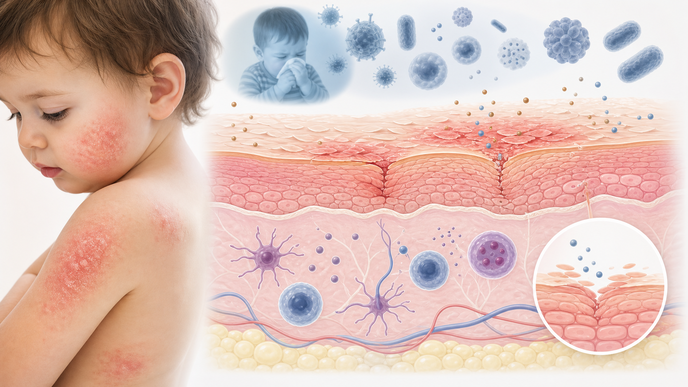
- Associations were mainly driven by respiratory infections, and the pattern held independently of filaggrin (FLG) gene variants and systemic antibiotic treatment — but the investigators said it does not prove that infections cause AD.
In a JAMA Dermatology analysis of early-life infection burden and childhood atopic dermatitis, investigators studied the Danish Copenhagen Prospective Studies on Asthma in Childhood 2010 (COPSAC2010) cohort of 663 children and the U.S. Vitamin D Antenatal Asthma Reduction Trial (VDAART) cohort of 707 children. Exposure was daily diary-registered infection episodes and days during ages 0 to 3 years. In COPSAC2010, categories included cold, acute otitis media, tonsillitis, pneumonia, gastroenteritis, and fever. AD risk in COPSAC2010 was assessed as yearly prevalence through age 10 using a generalized estimating equation (GEE) model, adjusted for FLG variant status and systemic antibiotic treatment. In VDAART, AD was based on parental report of physician diagnosis through age 6.
In COPSAC2010, children in the upper versus lower tertile of infection burden had higher adjusted odds of yearly AD prevalence for both infection episodes (AOR, 1.61; 95% CI, 1.05-2.47; P = .03) and infection days (AOR, 1.69; 95% CI, 1.11-2.58; P = .01). Each additional infection episode was also associated with higher AD risk, independent of systemic antibiotic treatment and FLG variants. Associations were mainly driven by respiratory infections.
A similar association appeared in VDAART, where upper- versus lower-tertile infection episodes were linked to higher AD odds through ages 0 to 6 years (OR, 1.76; 95% CI, 1.16-2.70; P = .01), and each additional infection episode raised the odds as well (OR, 1.03; 95% CI, 1.01-1.05; P = .002).
These associations do not establish causation, and directionality remains unsettled, since infection measurement and many AD diagnoses occurred during the same early-life window. The investigators noted that the pattern held even after accounting for FLG variants and systemic antibiotic exposure, which argues against those two factors alone explaining the link — though it doesn't rule out other shared susceptibility factors.
Overall, greater infection burden before age 3 years tracked with higher childhood AD odds across both cohorts, with a dose-response signal and persistently higher yearly prevalence in COPSAC2010. The investigators said the findings suggest a long-term relationship between early respiratory infections and AD that has previously been unclear due to inconsistent findings in prior studies, and that further work is needed to determine whether the relationship is causal or instead reflects shared susceptibility.
Clinician Questions
How was early infection burden defined in the childhood atopic dermatitis cohort analysis?
Early infection burden referred to infections during ages 0 to 3 years and was analyzed as both infection episodes and infection days. In COPSAC2010, categories included cold, acute otitis media, tonsillitis, pneumonia, gastroenteritis, and fever.
Which infection subtypes were most consistently linked to higher odds of childhood atopic dermatitis?
Associations were mainly driven by respiratory infections rather than across every infection category evaluated.
Why does the infection burden–atopic dermatitis association not establish causation?
The findings were observational, and directionality remains unresolved because infection measurement and many childhood atopic dermatitis diagnoses occurred during the same early-life period. The association held independent of FLG variants and systemic antibiotic treatment, but this doesn't rule out other shared underlying susceptibility.