
Early Inertial Training After ACL Reconstruction
Key Takeaways
- Added inertial training was associated with greater restoration of morphological symmetry and interlimb symmetry under inertial loading.
- Isokinetic knee strength and dynamic balance were comparable between groups at 12 weeks.
- Only the inertial-training group showed a significant increase in operated-limb muscle mass, and no adverse events were observed.
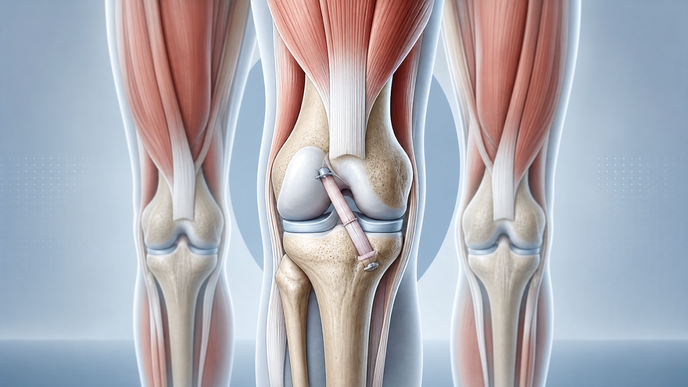
Researchers conducted a pilot randomized controlled trial in 24 adults after ACL reconstruction, comparing standard rehabilitation alone with the same program plus inertial exercises. The cohort ranged from 18 to 56 years of age and included 5 women and 19 men, with 12 participants in each group. All reconstructions were arthroscopic and used semitendinosus-gracilis autografts, and the work took place within a single rehabilitation company. Both groups completed the same 12-week program twice weekly, with sessions lasting about 60 minutes, and baseline assessments were obtained two weeks after surgery. Participants and physiotherapists were not blinded, but assessors were, and outcomes included thigh circumference, body composition, knee strength, and SEBT dynamic balance.
From week 7 through week 12, the added protocol used the closed kinetic chain seated InerKnee device under direct physiotherapist supervision. Participants performed four 15-second sets twice weekly, with 2-minute rests and a 60-degree range of motion. Uninvolved-limb maximal strength testing at the start of this phase was used to set the training load. Loading started at 60% of the uninvolved limb's maximal strength and increased by 10% every two weeks to 80% in the final phase. Maximal testing of the operated limb was not done before this phase for safety reasons, and the protocol reflects one supervised inertial implementation tested early after surgery.
At 12 weeks, the groups did not differ significantly in isokinetic knee extensor or flexor strength, and SEBT dynamic balance was also comparable. Differences emerged in symmetry measures, with greater restoration of morphological symmetry and interlimb strength symmetry under inertial loading in the inertial-training group. Those between-group differences met p<0.05 and were accompanied by a large effect size, with Cohen's d=1.37. Only the inertial-training group also showed a significant increase in muscle mass of the operated limb. The between-group separation remained confined to morphology and inertial-loading symmetry outcomes.
All interventions were well tolerated, and no adverse events were observed during rehabilitation. The study was a pilot trial with a small sample and no formal a priori sample-size calculation. Follow-up was limited to the first 12 postoperative weeks, which limits interpretation to early recovery. Morphological assessment also relied on segmental bioelectrical impedance analysis, an indirect measure of muscle mass. Within this supervised program, the observed advantages were confined to early postoperative morphology and inertial-loading symmetry.