
DKA at Adult Type 1 Diabetes Diagnosis Linked to Higher HbA1c
Key Takeaways
- Among adults with adult-onset type 1 diabetes attending a tertiary clinic in Padova, Italy, 21.7% had DKA at diagnosis.
- Those diagnosed during DKA had higher long-term HbA1c, with significantly less improvement after clinic entry.
- An exploratory retinopathy association was no longer statistically significant after adjustment for mean follow-up HbA1c.
- Within this clinic cohort, DKA at diagnosis rose from 13.2% in 2000–2008 to 34.6% after 2016.
In the retrospective cohort study of DKA at adult-onset type 1 diabetes diagnosis, investigators assessed 517 adults diagnosed with T1D at age 18 or older; 112 presented with DKA. A diabetes expert blinded to outcomes reviewed historical DKA classifications and adjudicated uncertain cases.
Patients attending the University Hospital of Padova Diabetes Outpatient Clinic during 2000–2025 entered the cohort at their first visit with systematic data, a mean 6.8 years after diagnosis. Adjusted repeated-measures models assessed glycated hemoglobin (HbA1c) at quarterly intervals after clinic entry and, separately, at annual intervals after diagnosis. Cox models assessed retinopathy of any grade documented by digital funduscopic examination. A diabetes-duration sensitivity model allowed delayed entry; retinopathy already present at entry could be assigned an entry-time event when its onset was unknown. Missing observations were not imputed.
From cohort entry, HbA1c improved by 0.37 percentage points less in the DKA group than in the group without DKA after adjustment (95% confidence interval [CI], 0.20–0.53; p < 0.001). Follow-up after entry was shorter among those diagnosed during DKA.
With measurements instead aligned to diagnosis, the estimated mean HbA1c difference between groups was 0.66 percentage points (p < 0.001). This estimate uses a different time origin and does not measure the difference in improvement from clinic entry.
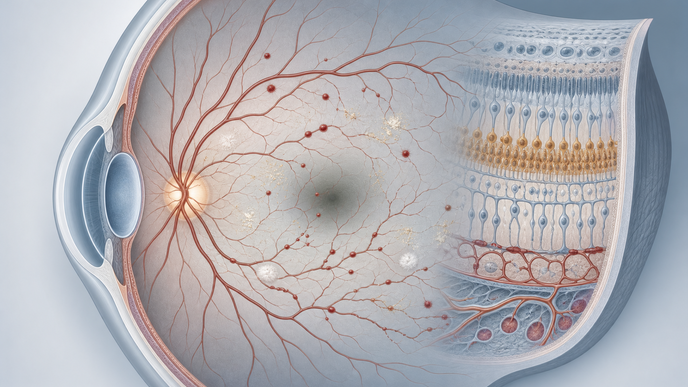
DKA at diagnosis was associated with documented retinopathy in an exploratory adjusted analysis (hazard ratio , 1.61; 95% CI, 1.02–2.55; p = 0.041). Some participants already had retinopathy at cohort entry, so documented cases were not all newly detected during clinic follow-up.
Using diabetes duration as the time scale and allowing delayed entry yielded an HR of 1.66 for retinopathy. After adjustment for mean follow-up HbA1c, the HR was 1.07 and the association was no longer statistically significant. Other assessed complication associations and changes in kidney measures did not differ significantly between groups.
Retrospective sampling at one tertiary clinic in Italy and enrollment after diagnosis limit generalizability. Delayed-entry modeling addresses differences in disease duration among enrolled adults, but not selection through survival, referral, access, or attendance before entry. Historical DKA classification, nonuniform HbA1c assessment and retinal screening, fewer HbA1c observations in the DKA group, and unavailable socioeconomic factors add uncertainty. Vital status after last contact was not systematically available. Retinopathy analyses were exploratory, lacked correction for multiple comparisons, and included few participants late in follow-up. Adjustment for follow-up HbA1c does not establish mediation.
In this Padova clinic cohort, investigators linked DKA at adult-onset T1D diagnosis to less favorable subsequent HbA1c. The exploratory retinopathy association weakened after accounting for mean follow-up HbA1c; these observational findings do not establish causation.
Clinician Questions
How was acute presentation without DKA defined in adults diagnosed with type 1 diabetes?
In the Padova adult-onset type 1 diabetes cohort, acute presentation without DKA meant diagnosis after an emergency visit or hospitalization for characteristic hyperglycemia symptoms when DKA criteria were not met. Investigators did not require a predefined biochemical hyperglycemia threshold for this category.
Did adults diagnosed with type 1 diabetes during DKA use insulin pumps or continuous glucose monitoring differently?
In the Padova cohort of adults with type 1 diabetes, those diagnosed during DKA were less likely to transition to insulin pump therapy during follow-up, including after adjustment for age at onset, sex, disease duration at entry, and calendar year of diagnosis. Continuous glucose monitoring use was similar between groups.
This content is intended for healthcare professionals for educational purposes. The article and its image were developed with AI assistance and reviewed by members of the ReachMD team prior to publication. Please refer to the original source linked for the complete and most up-to-date information.