
Depression Scores Linked to Ocular Outcomes in Diabetic Retinopathy
Key Takeaways
- Among newly diagnosed VTDR patients at three Chinese ophthalmology centers, poor final vision occurred in 67.8% with depressive symptoms versus 57.2% without them.
- Neovascular glaucoma occurred in 13.6% with depressive symptoms versus 6.9% without them.
- Among vitrectomy recipients, recurrent vitreous hemorrhage occurred in 21% with anxiety symptoms versus 10.6% without them, and in 20.3% with depressive symptoms versus 10.7% without them.
- Continuous depression scores remained associated with multiple ocular outcomes after adjustment, whereas the adjusted anxiety association was limited to poor final visual acuity.
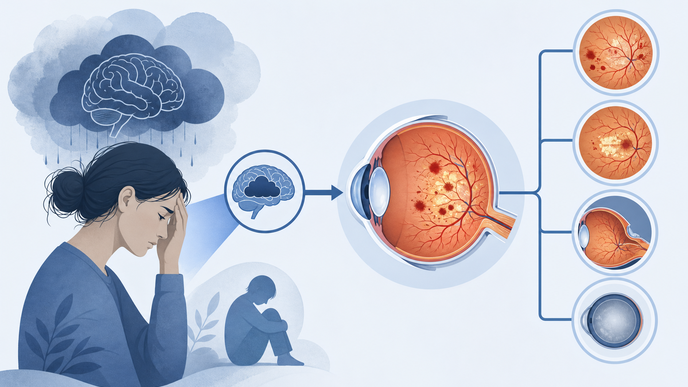
In Li and colleagues’ multicenter cohort in Depression and Anxiety, investigators retrospectively reviewed 782 newly diagnosed patients enrolled from January 2018 through December 2021 at three ophthalmology centers in Shanghai and Suzhou, China. Median follow-up was 24.8 months, and eligibility required at least a year of follow-up. VTDR included Early Treatment Diabetic Retinopathy Study (ETDRS)-graded severe nonproliferative or proliferative diabetic retinopathy, or clinically significant diabetic macular edema confirmed by optical coherence tomography (OCT). Before indicated panretinal photocoagulation, intravitreal anti–vascular endothelial growth factor treatment, dexamethasone implants, or pars plana vitrectomy, patients completed Hospital Anxiety and Depression Scale (HADS) subscales; a score of at least 8 identified symptoms, not a psychiatric diagnosis. Follow-up endpoints were fovea-involving tractional retinal detachment, neovascular glaucoma, final better-eye best-corrected visual acuity below 0.3, and recurrent vitreous hemorrhage among the 381 vitrectomy recipients. Logistic models adjusted for reported demographic, socioeconomic, systemic, and medication covariates.
Anxiety and depressive symptoms were detected before treatment. Categorical comparisons found no significant difference in fovea-involving detachment by either symptom status or in neovascular glaucoma by anxiety status. Depression-positive status, by contrast, was associated with poor final vision and neovascular glaucoma; both symptom categories were associated with recurrent hemorrhage among vitrectomy recipients. The categorical detachment finding differed from the adjusted association observed when depression was analyzed as a continuous score.
For each additional HADS depression-subscale point, the detailed Results estimated adjusted odds of fovea-involving tractional retinal detachment at 1.06 (95% confidence interval 1.01–1.12; p = 0.015). Higher depression scores were also associated after adjustment with poor final vision, recurrent postvitrectomy hemorrhage, and neovascular glaucoma; the depression-positive category also had an adjusted association with glaucoma. Continuous anxiety scores retained an adjusted association only with poor final visual acuity among these endpoints. The abstract gives different adjusted depression estimates for several endpoints than the detailed Results, from which the detachment estimate above is drawn.
Because these associations came from a retrospective cohort, they do not establish whether psychological symptoms caused ocular deterioration or whether screening or psychological treatment prevents it. The authors noted selection of hospital patients with complete records, potential measurement bias in records and self-reports, and symptom scores that may depend on clinical context or reflect a bidirectional relationship with eye disease. Psychiatric history may have gone uncaptured; psychotropic medication type, dose, and adherence were not examined. Changing metabolic control and lifestyle during follow-up could also affect the observed associations.
Li and colleagues reported broader adjusted associations across ocular outcomes for depressive symptom scores than for anxiety scores, whose adjusted association was limited to poor final vision. These were associations observed in patients with VTDR receiving indicated ocular treatment.
Clinician Questions
Which patients with vision-threatening diabetic retinopathy were excluded from the psychological-symptom outcome analysis?
The Chinese VTDR cohort excluded patients followed for less than one year, unable to access standardized ocular treatment, or living with severe visual impairment unrelated to diabetic retinopathy. Patients with missing mental-health or VTDR diagnostic data, or major psychological trauma that altered assessment, were also excluded.
How was a HADS depression score of 8 to 10 classified in patients with vision-threatening diabetic retinopathy?
In the VTDR cohort, a HADS depression-subscale score of at least 8 indicated screened depressive symptoms, not a confirmed psychiatric diagnosis. The Methods classified scores of 8–10 as borderline and scores above 10 as clinically significant, although the detailed Results also called the group scoring at least 8 clinically significant.
Did the adjusted models for depressive symptoms and vision-threatening diabetic retinopathy include baseline retinal stage or ocular treatment?
For depressive-symptom associations with ocular outcomes in the VTDR cohort, investigators adjusted for age, gender, education, marital status, self-reported economic burden, occupation, smoking, diabetes type and duration, glycated hemoglobin, low-density lipoprotein, systolic blood pressure, body mass index, anxiolytic or antidepressant medication use, diabetic nephropathy, and cardiovascular disease. Baseline ETDRS stage and specific ocular treatment were not listed adjustment covariates.
This content is intended for healthcare professionals for educational purposes. The article and its image were developed with AI assistance and reviewed by members of the ReachMD team prior to publication. Please refer to the original source linked for the complete and most up-to-date information.