
Cross-Sectional Coaxial Renal Biopsy Improved Adequacy
Key Takeaways
- In this single-center comparison of adult native kidney biopsies, the cross-sectional coaxial approach was associated with the highest specimen adequacy of the 3 ultrasound-guided techniques studied.
- It also produced the greatest glomerular yield, with specimen adequacy of 100% versus 97.8% for longitudinal coaxial biopsy and 89.1% for longitudinal noncoaxial biopsy.
- Procedure time was shortest with cross-sectional coaxial biopsy, averaging 1.45 minutes versus 2.22 minutes with longitudinal coaxial biopsy and 2.61 minutes with longitudinal noncoaxial biopsy.
- Bleeding endpoints favored the cross-sectional coaxial approach over the noncoaxial technique, gross hematuria was more frequent than with longitudinal coaxial biopsy, and no major hemorrhagic events requiring embolization were reported.
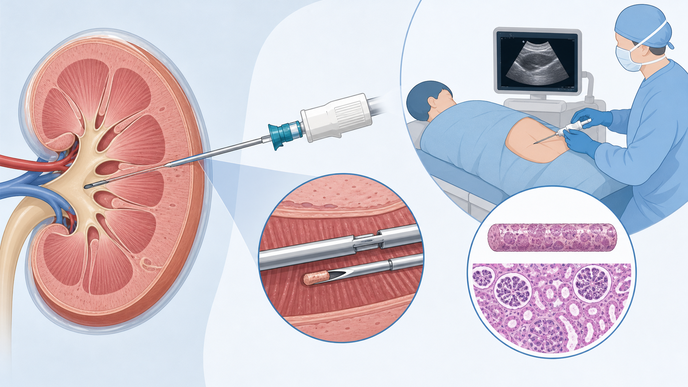
Investigators retrospectively compared 3 real-time ultrasound-guided percutaneous renal biopsy techniques in adults at Anhui Provincial Public Health Clinical Center in China from 2019 through 2025 in a cross-sectional comparison. The cohort included 184 adults: 47 underwent cross-sectional coaxial biopsy, 45 underwent longitudinal coaxial biopsy, and 92 underwent longitudinal noncoaxial biopsy, with specimen adequacy defined as at least 10 glomeruli. The cross-sectional coaxial approach targeted the mid-to-lower pole cortex, whereas both longitudinal approaches targeted the lower pole; procedures were performed or supervised by 2 experienced interventional radiologists, and coaxial cases paired 18- or 16-gauge biopsy needles with 17- or 15-gauge coaxial needles. Outcomes were total glomerular yield, procedural time, and bleeding complications, with immediate ultrasound monitoring for 5 to 10 minutes followed by 24 hours of supine bed rest and 48 hours of clinical surveillance.
Specimen adequacy was 100% in Group A, 97.8% in Group B, and 89.1% in Group C, with a significant advantage for Group A versus Group C (p = 0.016). Total glomerular yield was 26.9 ± 9.9, 22.93 ± 10.75, and 20.87 ± 11.50 across the 3 groups; yield was significantly higher in Group A vs Group C and in Group B vs Group C, but not significantly different between Groups A and B (p = 0.236). Procedural time was 1.45 ± 0.20, 2.22 ± 0.35, and 2.61 ± 0.46 minutes, with all pairwise comparisons p < 0.001. Baseline characteristics were otherwise comparable, and no meaningful needle-gauge imbalance was reported across groups.
No major complications requiring embolization or prolonged hospital stay due to complications were reported. Versus the longitudinal noncoaxial group, the cross-sectional coaxial group had significantly lower perinephric hematoma, gross hematuria, and microscopic hematuria (p < 0.001, p = 0.002, and p = 0.004, respectively). Gross hematuria was significantly more frequent with cross-sectional coaxial biopsy than with longitudinal coaxial biopsy (p = 0.004), while other bleeding differences between the 2 coaxial groups were not significant.
Interpretation remains limited by the retrospective single-center design, relatively small sample, and operator-selected technique assignment rather than random allocation. Subgroup analyses were not performed for needle gauge, body mass index, or renal disease type. Because this experience came from one center in China, direct generalizability to U.S. or other practice settings is uncertain. Within this center’s adult native kidney biopsy practice, the cross-sectional coaxial approach was associated with higher adequacy, greater sampling efficiency, and shorter procedure time, while the clearest bleeding advantage was over the noncoaxial technique rather than uniformly across all coaxial comparisons.
The authors concluded that the cross-sectional coaxial technique was associated with higher technical success, shorter procedural duration, and fewer hemorrhagic complications in this cohort, and they called for larger randomized multicenter studies.
Clinician Questions
Which renal biopsy patients do these technique comparisons apply to?
The analysis covered adults undergoing real-time ultrasound-guided native kidney biopsy at a single tertiary center and excluded pediatric patients, transplant kidney biopsy, focal renal tumor biopsy, and computed tomography-guided biopsy. The findings therefore apply to an adult native-kidney biopsy setting rather than to all renal biopsy populations.
How was technical success defined for ultrasound-guided renal biopsy in this comparison?
Technical success was defined as obtaining at least 10 glomeruli for histologic adequacy. That threshold served as the study’s measure of specimen adequacy across all 3 biopsy techniques.
What procedural features distinguished the cross-sectional coaxial renal biopsy approach from the other techniques?
The cross-sectional coaxial approach used transverse ultrasound probe orientation, targeted the mid-to-lower renal pole cortex, and paired the biopsy needle with a coaxial sheath. The comparison groups used longitudinal guidance at the lower pole, with or without coaxial access, and the authors interpreted the transverse approach as offering a broader cortical target zone and a more stable insertion angle.