
Conduction System Pacing Lowers PICM vs RV Pacing
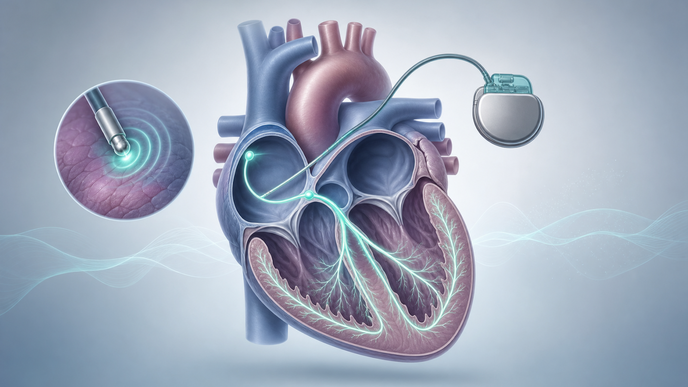
Key Takeaways
- In randomized trials of patients with atrioventricular block or high anticipated ventricular pacing burden undergoing conduction system pacing versus right ventricular pacing, pacing-induced cardiomyopathy was less frequent with conduction system pacing.
- Left ventricular ejection fraction was better preserved with conduction system pacing, although the pooled estimate varied across trials.
- Conduction system pacing was associated with lower heart failure hospitalization and a shorter paced QRS duration than right ventricular pacing.
- All-cause mortality was numerically lower with conduction system pacing but did not differ significantly in the pooled analysis.
- A prespecified sensitivity analysis limited to larger multicenter trials showed findings that remained directionally consistent with the primary analysis.
In a systematic review and meta-analysis of conduction system pacing versus right ventricular pacing, researchers compared conduction system pacing (CSP) with right ventricular pacing (RVP) in patients with AV block or anticipated high ventricular pacing burden, requiring at least 6 months of follow-up. The analysis included five randomized controlled trials — LBBP-FAVOUR, CSPACE, Prague CSP, PACE-HF, and STAY — with 806 total participants; co-primary outcomes were PICM incidence and change in left ventricular ejection fraction (LVEF), and secondary outcomes were heart failure hospitalization (HFH), all-cause mortality, composite clinical endpoint, and paced QRS duration. The work was registered in PROSPERO as CRD420261400227 and used a random-effects meta-analysis with DerSimonian-Laird estimation.
CSP was associated with lower PICM than RVP, with hazard ratio 0.30, 95% confidence interval 0.18–0.48, p<0.001, I²=0%, k=4. Change in LVEF also favored CSP by a pooled mean difference of +4.41%, 95% confidence interval +1.82 to +6.99, p=0.001, I²=87%, k=5, indicating substantial variation across trials in the ventricular function signal.
HFH was lower with CSP, with hazard ratio 0.24, 95% confidence interval 0.12–0.48, p<0.001, I²=0%, k=5, and paced QRS duration was shorter, with mean difference −27.5 ms, 95% confidence interval −32.6 to −22.5, p<0.001, k=5. All-cause mortality was numerically lower but not statistically significant, with hazard ratio 0.57, 95% confidence interval 0.29–1.12, p=0.10, k=4. A prespecified sensitivity analysis restricted to multicenter trials with N≥150 was concordant with the primary analysis.
The main contrast in the pooled findings was that LVEF preservation appeared less uniform across studies, whereas the PICM and HFH results moved in a more consistent direction. The mortality comparison remained inconclusive, so the randomized evidence was more firmly centered on remodeling and hospitalization outcomes than on survival.
The authors concluded that CSP was associated with less PICM, better preservation of ventricular function, and fewer heart failure hospitalizations than RVP in the enrolled trial populations with AV block or high anticipated pacing burden, which largely had preserved or mildly reduced LVEF, although longer procedure and fluoroscopy times and higher lead-revision/dislodgement rates were also reported in some CSP cohorts; the mortality signal did not reach statistical significance.
Clinician Questions
Which patients were included in the meta-analysis of conduction system pacing versus right ventricular pacing?
The pooled analysis included patients with atrioventricular block or anticipated high ventricular pacing burden, drew from five randomized controlled trials — LBBP-FAVOUR, CSPACE, Prague CSP, PACE-HF, and STAY — enrolled 806 total participants, and required at least 6 months of follow-up.
What did the larger multicenter trials show for conduction system pacing versus right ventricular pacing?
A prespecified sensitivity analysis limited to multicenter trials with N≥150 was concordant with the primary analysis, meaning the direction of benefit for pacing-induced cardiomyopathy, left ventricular ejection fraction preservation, and heart failure hospitalization did not materially change.
Was left ventricular ejection fraction better preserved with conduction system pacing than with right ventricular pacing?
Change in left ventricular ejection fraction favored conduction system pacing by a pooled mean difference of +4.41%, with a 95% confidence interval of +1.82 to +6.99 and p=0.001, and heterogeneity across trials was high at I²=87%.
Did all-cause mortality differ between conduction system pacing and right ventricular pacing in patients with AV block?
All-cause mortality was numerically lower with conduction system pacing but was not statistically significant in the pooled analysis, with hazard ratio 0.57, 95% confidence interval 0.29–1.12, p=0.10, across four contributing trials.