
Coded Stress Not Linked to Most First Skin Disease Diagnoses
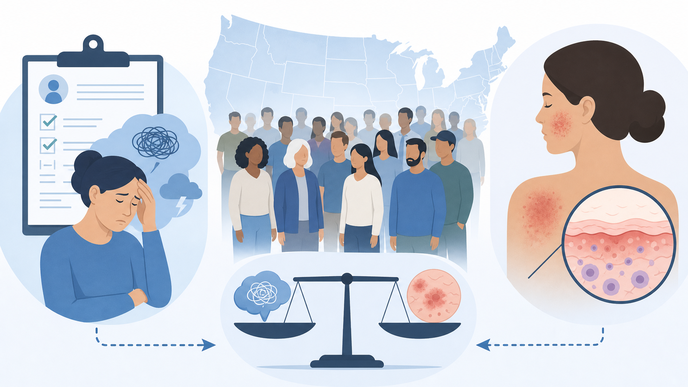
Key Takeaways
- Among adults in U.S. electronic health records, coded psychological stress was not consistently associated with increased first-recorded incidence of seven of eight individually assessed inflammatory skin diseases.
- A modest uncalibrated hidradenitis suppurativa association did not meet the prespecified multiple-testing criterion after bias calibration, although it remained nominally significant.
- Negative controls revealed systematic error in the initial comparisons that empirical calibration addressed.
- Stress-coded adults had more ambulatory encounters, potentially affecting detection of symptomatic disease.
Curman and colleagues conducted a retrospective, propensity-score-matched cohort study using electronic health records (EHRs) from the U.S. Collaborative Network of TriNetX. The analysis included 399,615 matched adult pairs, with median follow-up of 7.1 years. Exposure was a first F43 diagnosis, covering reaction to severe stress and adjustment disorders, or Z73.3, stress not elsewhere classified, during 2015–2018. Comparators had a first Z00 general health examination without a stress code on or before that index date. Matching accounted for documented characteristics, comorbidities, and healthcare use. First codes for separate skin conditions were counted from the following day; patients with a prior code for a particular condition were excluded from that endpoint. Cox time-to-event comparisons were checked in sensitivity analyses and multivariable models, with negative controls used for empirical calibration. The investigators prespecified a Bonferroni-adjusted significance criterion across the skin outcomes.
Atopic dermatitis, psoriasis vulgaris, vitiligo, lichen planus, alopecia areata, acne vulgaris, and rosacea showed no consistent increase across the principal comparisons and robustness analyses. These were separate diagnoses, not components of a reported pooled inflammatory skin disease estimate. Hidradenitis suppurativa differed in the uncalibrated comparison, with a hazard ratio (HR) of 1.20 (95% confidence interval [CI] 1.13–1.27). Before calibration, 10 of 22 negative controls crossed the prespecified significance threshold, indicating systematic error.
After empirical calibration, the hidradenitis suppurativa estimate was HR 1.17 (95% CI 1.00–1.37), with calibrated p = 0.049. That p value was nominally significant but did not meet the prespecified multiple-testing criterion; no negative control crossed that criterion after calibration. Positive-control associations with depression and burns persisted. Under the investigators’ specified assumptions, a model of undocumented stress among comparators did not overturn the largely null pattern. That model did not measure stress that had gone unrecorded.
A coded stress diagnosis cannot capture all experienced stress, and the absence of an earlier skin-disease code does not establish biological onset. Stress-coded adults had more ambulatory visits, potentially increasing opportunities to record symptomatic hidradenitis suppurativa. Residual confounding, coding variation, and symptoms that preceded a stress code further limit interpretation. These U.S. healthcare-record findings concern first recorded diagnoses, not flares or severity of established disease, and do not establish a causal effect of psychological stress.
Curman and colleagues concluded that documented stress was not a consistent population-level predictor of first recorded inflammatory skin disease in the U.S. cohort. They could not clearly separate the apparent hidradenitis suppurativa exception from systematic error after calibration; the findings do not establish whether experienced stress can trigger or worsen existing disease.
Clinician Questions
Why can first-recorded adult acne after a stress diagnosis differ from new-onset acne vulgaris?
In the U.S. EHR cohort, acne vulgaris could have begun in adolescence yet first received a diagnosis code in adulthood after the stress-code encounter. Incidence meant first recording, not proof of biological onset.
Which stress diagnosis codes contributed most to the skin-disease comparisons?
F43, the reaction-to-severe-stress and adjustment-disorders code, supplied the overwhelming majority of stress exposures in the U.S. EHR cohort; Z73.3, the stress-not-elsewhere-classified code, contributed far fewer. The authors cautioned that this distribution could reflect U.S. documentation conventions rather than stress severity.
Did skin-related negative controls indicate more dermatologic surveillance after coded stress?
Seborrheic keratosis and melanocytic nevi were recorded less often among stress-coded adults than among matched general-examination comparators, despite more ambulatory visits overall. The researchers interpreted ascertainment as depending on how a condition enters care, not as evidence of greater skin-specific surveillance or an independent measure of hidradenitis suppurativa detection.
Recommended Reading
- For more on early recognition of hidradenitis suppurativa: Catching HS Before Scarring Sets In
This content is intended for healthcare professionals for educational purposes. The article and its image were developed with AI assistance and reviewed by members of the ReachMD team prior to publication. Please refer to the original source linked for the complete and most up-to-date information.