
Closed vs Open Suctioning in ARDS: Early Lung Impedance
Key Takeaways
- Among mechanically ventilated adults with ARDS receiving PEEP ≥5 and <10 cmH₂O in a Beijing intensive care unit, closed suctioning was associated with smaller early losses of global lung impedance.
- The authors reported earlier global impedance recovery after open suctioning than after closed suctioning, based on comparisons with baseline.
- Closed suctioning showed an early SpO₂ advantage, but the later PaO₂/FiO₂ comparison was not statistically significant.
- Extubation and survival did not differ significantly between suction methods, and investigators recorded no adverse events.
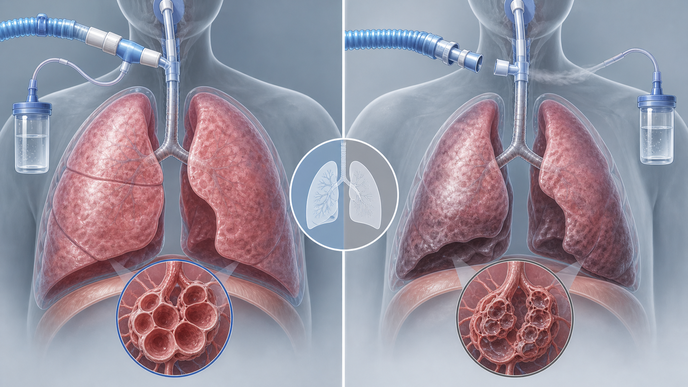
In a trial of open versus closed suctioning in ARDS, 60 adults at the Third Medical Center of Chinese PLA General Hospital in Beijing, China, were randomized, with 30 assigned to each method. Conducted from June 2025 through February 2026, the prospective, single-center, parallel-group trial enrolled patients receiving PEEP ≥5 and <10 cmH₂O. Allocation was concealed with opaque numbered envelopes, and the modified intention-to-treat population comprised randomized patients who underwent the assigned procedure. Open suctioning disconnected the ventilator circuit; closed suctioning left it intact. All participants were supine on volume-controlled lung-protective ventilation, received the same pre-oxygenation protocol, and underwent no post-suction recruitment maneuver. Electrical impedance tomography (EIT) measured global and regional change in end-expiratory lung impedance (ΔEELI), an indicator of change in end-expiratory lung volume rather than a direct absolute-volume measurement. Investigators tracked serial peripheral oxygen saturation (SpO₂), assessed arterial oxygen partial pressure/fraction of inspired oxygen (PaO₂/FiO₂) at baseline and after the short observation period, and measured extubation and survival as secondary outcomes.
At one minute, global ΔEELI was −0.54 ± 0.18 with closed suctioning versus −2.32 ± 1.34 with open suctioning. At 10 minutes, it was −0.31 ± 0.25 versus −1.14 ± 0.80, respectively; both comparisons had P < .001. More negative values represented greater impedance loss. Regional differences chiefly involved regions 1–3, while the most gravity-dependent fourth region showed no significant between-group effect.
The authors reported earlier global impedance recovery after open suctioning than after closed suctioning—by 20 versus 30 minutes—based on comparisons with baseline. At one minute, SpO₂ was 99.03 ± 1% with closed suctioning versus 98.07 ± 1% with open suctioning (P = .007). Saturation also returned to baseline sooner with closed suctioning. The later PaO₂/FiO₂ comparison was not statistically significant, nor were comparisons of extubation and survival. Investigators observed no adverse events under the trial’s monitoring protocol.
The authors noted the limited, single-center sample, lack of blinding for operators and data collectors, short physiologic observation, and limited power to distinguish secondary clinical outcomes. All participants were supine, received volume-controlled ventilation and pre-oxygenation, and had PEEP within the eligibility range. Those conditions bound interpretation of the transient saturation difference; the authors noted that pre-oxygenation may have attenuated desaturation. Effects at higher PEEP or with other ventilation modes were not established.
According to the authors, closed suctioning was associated with less early impedance loss and better early oxygen saturation, although their comparisons with baseline suggested earlier global impedance recovery after open suctioning. Whether these physiologic differences affect clinical outcomes remains unresolved.
Clinician Questions
How was successful extubation defined after open versus closed suctioning in ventilated ARDS?
For adults with ARDS randomized to open or closed endotracheal suctioning, successful extubation meant no reintubation within 48 hours. This definition specified the trial’s secondary extubation outcome.
Which adverse events were monitored after open or closed endotracheal suctioning in ARDS?
Among mechanically ventilated adults with ARDS undergoing open or closed endotracheal suctioning, investigators tracked oxygen desaturation, defined as SpO₂ below 90%, and arrhythmia during suctioning and for 30 minutes afterward.