
Claudin-4 Identified as BFT Receptor in Colorectal Cancer
Key Takeaways
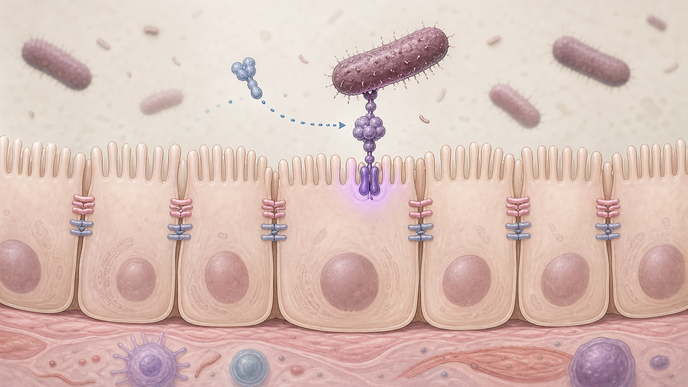
- Bacteroides fragilis toxin was reported to require attachment to claudin-4 before it could injure colon cells.
- A genomewide CRISPR screen in colon epithelial cells identified claudin-4 as the clear top host factor for BFT activity, and claudin-4 loss prevented toxin attachment while leaving E-cadherin unharmed.
- Biophysical experiments showed a tightly bound one-to-one BFT-claudin-4 complex, and a soluble claudin-4 decoy protected mice from BFT-induced colon damage.
Enterotoxigenic Bacteroides fragilis is found in up to 20% of healthy people, although certain strains have been described as able to trigger colonic inflammation and promote tumor growth. Prior work had linked BFT-mediated E-cadherin cleavage to barrier injury and colon tumor formation, and the new research addressed the earlier unanswered receptor step that appears to precede that downstream damage. In a genomewide CRISPR screen of colon epithelial cells, claudin-4 emerged as the clear top host factor required for BFT activity.
That screening result was then tied to function in the same experimental system. When claudin-4 was removed, the researchers reported that BFT no longer attached to colon epithelial cells, and E-cadherin remained unharmed. The study places claudin-4 upstream of the previously recognized E-cadherin injury pathway.
Separate biophysical experiments showed that BFT and claudin-4 formed a tightly bound one-to-one complex, providing direct evidence of receptor-toxin engagement in vitro. The investigators then extended that observation in mice, where a soluble claudin-4 decoy diverted BFT away from colon cells and protected mice from BFT-induced colon damage, without establishing human efficacy or clinical utility. The authors also noted that the precise experimental structure of the BFT-claudin-4 interaction has not yet been captured, and AI modeling tools including AlphaFold did not fully resolve that interface.
Clinician Questions
What host receptor did Bacteroides fragilis toxin use to reach colon epithelial cells?
The researchers reported in preclinical experiments that Bacteroides fragilis toxin attached to claudin-4 before injuring colon cells, and claudin-4 emerged as the key host factor in a genomewide CRISPR screen of colon epithelial cells.
What happened when claudin-4 was removed in the BFT colon-cell experiments?
When claudin-4 was removed, BFT could no longer attach to colon epithelial cells and E-cadherin remained unharmed.
Did a soluble claudin-4 decoy block Bacteroides fragilis toxin in mice?
The investigators created a soluble version of claudin-4 that acted as a molecular decoy, diverted BFT away from colon cells, and protected mice from BFT-induced colon damage.
What remains unresolved about the BFT-claudin-4 interaction?
The researchers had not yet captured the precise experimental structure showing how BFT and claudin-4 fit together, and AI modeling tools including AlphaFold did not fully resolve the interaction.