
CKD Stage Predicts Outcomes After Left Main PCI
Key Takeaways
- In patients undergoing intracoronary imaging-guided percutaneous coronary intervention for de novo left main disease in a Japanese multicenter registry, 3-year major adverse cardiovascular and cerebrovascular event rates increased with worsening chronic kidney disease and were significantly higher in CKD stages IV and V versus CKD I/II.
- All-cause mortality increased with worsening chronic kidney disease stage and was similarly high in CKD IV and V, accounting for much of the excess long-term risk.
- Chronic kidney disease stages IIIb and IV more often presented with acute instability, whereas stage V showed greater lesion complexity.
- Clinically driven revascularization did not increase in parallel with worsening chronic kidney disease stage.
In the LM-JANHO registry study in The American Journal of Cardiology, investigators reviewed a multicenter retrospective observational registry from 19 Japanese National Hospital Organization hospitals of de novo left main lesions treated with drug-eluting stents under routine intracoronary imaging guidance, usually with intravascular ultrasound (IVUS), optical coherence tomography (OCT), or optical frequency domain imaging (OFDI). Between January 2016 and December 2020, 806 consecutive patients were enrolled, 29 were excluded for ineligibility, 21 for incomplete 3-year follow-up data, and 756 were analyzed. CKD stage at index PCI was defined by baseline estimated glomerular filtration rate (eGFR): I/II at least 60 ml/min/1.73 m2 (n=360), IIIa 45 to less than 60 (n=212), IIIb 30 to less than 45 (n=105), IV 15 to less than 30 (n=40), and V less than 15 (n=39). The primary endpoint was 3-year major adverse cardiovascular and cerebrovascular events (MACCE), composed of all-cause death, myocardial infarction, clinically driven revascularization, and cerebrovascular disorders, with annual follow-up for up to 3 years.
Patients with CKD IIIb and IV had heavier comorbidity burden and more unstable presentations, including acute coronary syndrome (ACS), cardiogenic shock, pulmonary edema, and more frequent mechanical circulatory support. Acute coronary syndrome was most common in CKD IIIb at 47.6% versus 25.6% in CKD V. CKD V showed fewer catastrophic presentations but greater lesion complexity, with true bifurcation lesions reaching 53.1% and with more proximal left circumflex involvement, planned 2-stent treatment, and rotational or orbital atherectomy.
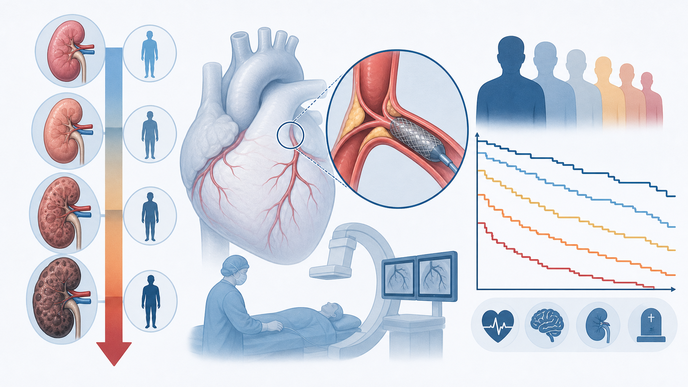
At 3 years, 3-year CKD-stage outcomes after imaging-guided left main PCI showed MACCE rates of 28.9%, 31.3%, 35.7%, 45.8%, and 48.7% from CKD I/II through V. Risk versus CKD I/II was significantly higher in CKD IV with hazard ratio (HR) 1.94 (95% confidence interval [CI] 1.16-3.24) and CKD V with HR 2.32 (95% CI 1.41-3.84). All-cause mortality increased with worsening CKD stage and was similarly high in CKD IV and V; CKD stage IIIb or higher independently predicted death with adjusted HR 1.77 (95% CI 1.16-2.70; p=0.008), but not MACCE or clinically driven revascularization after adjustment. Clinically driven revascularization did not rise with worsening CKD severity, and CKD IIIb was lower than CKD I/II in the competing-risk analysis.
Because this retrospective observational registry came from Japanese centers, the authors described the findings as hypothesis-generating rather than broadly generalizable. SYNTAX score was not systematically collected, intracoronary imaging optimization criteria were not standardized across centers, cause-specific mortality and complications attributable to mechanical circulatory support were not centrally adjudicated, and comparison with angiography-guided PCI was not possible because nearly all patients underwent imaging-guided PCI. For North American clinicians, the findings mainly describe a Japanese, near-universal imaging-guided practice environment. Even so, advanced predialysis CKD and CKD stage V appeared to carry different mixes of hemodynamic instability and anatomic complexity.
The authors reported that worsening CKD stage was associated with progressively worse outcomes after contemporary imaging-guided left main PCI, with excess long-term risk driven more by mortality than by repeat revascularization. They also noted that the distinct presentation patterns of CKD IIIb-IV and CKD V may help explain why advanced CKD did not appear clinically uniform within this cohort.
Clinician Questions
How was CKD staged in patients undergoing left main PCI in the LM-JANHO registry?
CKD staging at the index left main PCI was based on baseline eGFR across 5 strata: CKD I/II at least 60 ml/min/1.73 m2, IIIa 45 to less than 60, IIIb 30 to less than 45, IV 15 to less than 30, and V less than 15.
What made the CKD IIIb-IV group look different from the CKD V group before long-term outcomes were counted?
CKD IIIb and IV were marked by more acute coronary syndrome presentation, cardiogenic shock, pulmonary edema, and more frequent mechanical circulatory support, whereas CKD V showed fewer catastrophic presentations but more complex anatomy such as true bifurcation disease, proximal left circumflex involvement, greater use of 2-stent strategies, and more rotational or orbital atherectomy.
What did clinically driven revascularization include after left main PCI in this registry?
Clinically driven revascularization included target vessel and nontarget vessel repeat revascularization performed for ischemic indications; target lesion revascularization referred to repeat PCI or coronary artery bypass grafting involving the treated left main segment or adjacent proximal left anterior descending and/or left circumflex artery within 5 mm of the bifurcation.
What limits how far the LM-JANHO CKD findings can be generalized outside Japan?
Generalizability is limited because this was a retrospective observational registry from Japanese National Hospital Organization centers, SYNTAX score was not systematically collected, imaging optimization criteria were not standardized across centers, cause-specific mortality and mechanical-support complications were not centrally adjudicated, and the near-universal use of imaging-guided PCI did not allow direct comparison with angiography-guided PCI; the authors described the findings as hypothesis-generating.