
Cagrilintide-Semaglutide Added to Basal Insulin in REIMAGINE 3
Key Takeaways
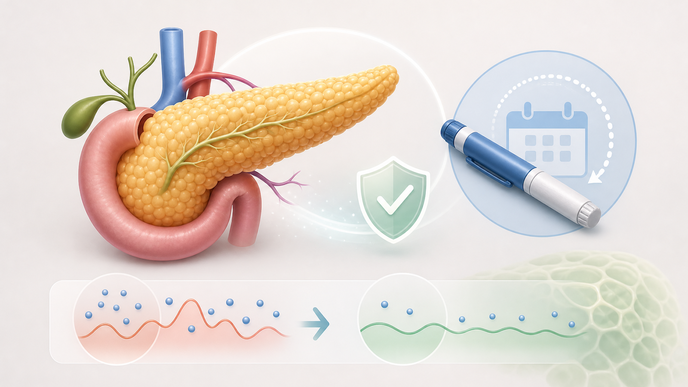
- Once-weekly cagrilintide-semaglutide added to basal insulin was associated with larger week-40 HbA1c reductions than placebo.
- Body weight decreased by 10% to 12% across the active-dose groups.
- Adverse events were mostly mild or moderate gastrointestinal disorders, and no severe hypoglycemia was reported.
REIMAGINE 3 was a double-blind, parallel-group, randomized, controlled phase 3a study conducted at 46 centers in the USA, China, Japan, Serbia, Slovakia, and South Africa. Eligible participants were adults with type 2 diabetes, HbA1c 7.0% to 10.5%, and stable once-daily basal insulin therapy with or without metformin. Randomization was 2:2:1:1 to once-weekly subcutaneous cagrilintide-semaglutide 2.4 mg each, cagrilintide-semaglutide 1.0 mg each, or one of two dose-matched placebo regimens for 40 weeks. Among 340 screened individuals, 274 were randomized; 159 were men, 115 were women, and mean baseline HbA1c was 8.8%. Participants, care providers, investigators, and outcome assessors were masked within dose level with visually identical placebo, and the primary endpoint was mean HbA1c change to week 40.
In the 2.4 mg each, 1.0 mg each, and pooled placebo groups, mean HbA1c changes at week 40 were -2.33%, -2.10%, and -0.66%, respectively. Using the efficacy estimand, treatment differences versus placebo were -1.68 percentage points for 2.4 mg each and -1.44 percentage points for 1.0 mg each. The corresponding 95% confidence intervals were -1.95 to -1.41 and -1.71 to -1.17. Both comparisons had p values below 0.0001. Cagrilintide-semaglutide was also associated with bodyweight reductions of 10% to 12%, and both doses achieved the primary endpoint against placebo at week 40.
Adverse events occurred in 80% of the 2.4 mg each group, 71% of the 1.0 mg each group, and 71% of placebo recipients. These events were mostly mild or moderate gastrointestinal disorders, and no severe hypoglycemia was reported. One death occurred in the 1.0 mg each group and was unrelated to treatment, with malignancy listed as the cause. Investigators described the safety profile as consistent with the GLP-1 receptor agonist class and with previous safety data reported for cagrilintide.
The authors said the results support add-on use to once-daily basal insulin for glycemic control.