
Birth Weight Linked to Later Executive Function in ECHO Study
Key Takeaways
- In a longitudinal observational analysis of 1,295 participants from 6 cohorts, early-life exposures measured before age 6 years were associated with EF profiles assessed later at ages 6 to 15 years.
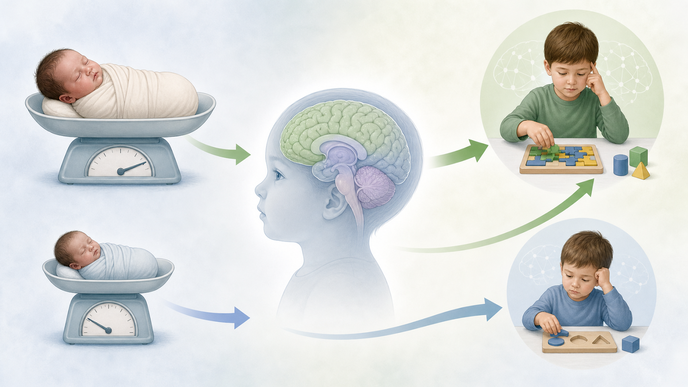
- Across analytic methods, language measured at the same time as EF was the strongest overall predictor, and birth weight was the most consistent early-life predictor.
- Network analysis linked working memory positively with birth weight and caregiver education, inhibitory control positively with household income, and cognitive flexibility negatively with preterm delivery.
- Neither network nor tree-based models identified meaningful direct associations between individual maternal ACEs and later EF measures.
Across methods, the signal converged on concurrent language and birth weight, with random forests consistently ranking TPVT as the most important predictor and birth weight second, while the network and tree models reinforced that pattern for early-life factors. In the network analysis, working memory was positively associated with birth weight and caregiver education, inhibitory control was positively associated with household income, and cognitive flexibility was negatively associated with preterm delivery; maternal ACEs showed no meaningful direct associations with EF. In the conditional inference tree, the first split was TPVT >91 versus ≤91, with mean scores of 96.3 versus 88.8 for DCCS, 102.7 versus 88.4 for LSWM, and 97.2 versus 88.4 for Flanker, followed by later birth-weight splits at 3171 g and 3110 g. Taken together, the results indicated that language dominated the concurrent cognitive signal while birth weight remained the most stable early-life marker across analytic approaches.
Because language and EF were measured at the same visit window, the temporal ordering between those cognitive measures could not be determined. The analyses were associational and did not establish causality, and the authors noted that birth weight may function as a summary index of broader prenatal influences rather than an independent causal factor. Unmeasured factors such as home cognitive stimulation or parenting quality could also have shaped the observed pattern, and participants were selected for data completeness rather than to represent the full ECHO population. In sensitivity analyses, adding cohort identifier changed ctree R2 only slightly, from 0.322 to 0.323 for DCCS, from 0.336 to 0.346 for LSWM, and from 0.227 to 0.256 for Flanker, leaving the main structure of the findings largely unchanged.
The authors concluded that specific early-life exposures showed distinct associations with later EF across domains rather than a uniform effect of broad risk categories. In these analyses, birth weight stood out as the most consistent early-life predictor across methods, and individual maternal ACEs did not show meaningful direct associations with EF measures.
Clinician Questions
Which early-life factor was most consistently linked to later executive function in the ECHO pediatric analysis?
Across network, random-forest, and conditional inference tree analyses in children from 6 ECHO cohorts, higher birth weight was the most consistent early-life factor associated with better later executive function, while language measured at the same time as executive function was the strongest overall concurrent predictor.
How were working memory, inhibitory control, and cognitive flexibility linked to specific early-childhood exposures in the ECHO cohorts?
In children from the ECHO cohorts, working memory was positively associated with birth weight and caregiver education, inhibitory control was positively associated with household income, and cognitive flexibility was negatively associated with preterm delivery, with those links estimated while controlling for the other modeled variables.
Were maternal adverse childhood experiences directly associated with executive function in children from the ECHO cohorts?
Neither the network analysis nor the tree-based analyses identified meaningful direct associations between individual maternal adverse childhood experiences and executive-function measures in this pediatric ECHO sample.