
Benralizumab Cuts Flares in Phase 3 Hypereosinophilic Syndrome Trial
Key Takeaways
- Benralizumab was associated with fewer HES flares and lower relapse measures than placebo during the 24-week double-blind period.
- Near-complete blood eosinophil depletion and fewer corticosteroid dose increases were observed with benralizumab during double-blind treatment.
- Overall adverse-event rates were similar between groups, and no treatment-related serious adverse events were identified.
NATRON was a randomized, double-blind, placebo-controlled phase 3 study in FIP1L1::PDGFRA-negative HES that included 133 patients who received at least 1 dose of treatment. Participants were aged 12 years or older and were assigned 1:1 to benralizumab 30 mg every 4 weeks or placebo for 24 weeks on background therapy. The median age was 51 years, 62% were female, most had idiopathic HES, and 12% had lymphocytic HES. About three-quarters were receiving systemic oral corticosteroids at enrollment. The primary endpoint was time to first HES flare, defined by clinical manifestations and treatment intensification rather than eosinophil counts alone.
HES flare occurred in 19.4% of patients receiving benralizumab and 42.4% receiving placebo during the double-blind period. The annualized flare rate was 0.41 versus 1.23 flares per year, with a rate ratio of 0.34 and a 95% confidence interval of 0.18 to 0.63. Benralizumab also delayed time to first hematologic relapse, with a hazard ratio of 0.08, and separation between groups was evident by week 4. PROMIS Fatigue improved at week 24, with a least-squares mean difference of -4.72 and a 95% confidence interval of -7.64 to -1.80.
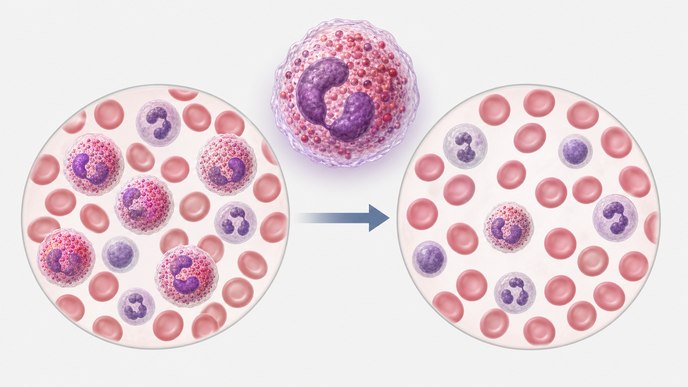
Blood eosinophils fell to near-complete depletion with benralizumab, whereas they increased and remained higher with placebo in FIP1L1::PDGFRA-negative HES. Sustained absolute eosinophil counts below 500 cells/µl over 24 weeks occurred in 91.0% versus 12.1%, with an odds ratio of 87.87. During the same period, 25.4% of benralizumab-treated patients and 48.5% of placebo-treated patients required a corticosteroid dose increase.
Adverse events occurred in 64.2% of benralizumab-treated patients and 66.7% of placebo-treated patients, while serious adverse events occurred in 7.5% and 7.6%. Five patients in each group had a serious adverse event, and none were considered treatment related. One death from sepsis occurred in the benralizumab group and was judged unrelated to treatment; common adverse events included headache, upper respiratory tract infection, and COVID-19. Anti-drug antibodies showed no consistent effect on efficacy, safety, or pharmacokinetics, although the number of ADA-positive patients was small.
The 24-week period limits long-term conclusions, life-threatening HES was excluded, subgroup inference was limited by sample size, and the open-label extension is ongoing.