
BALF mNGS in ICU IPA: Higher Yield, Lower Mortality Link
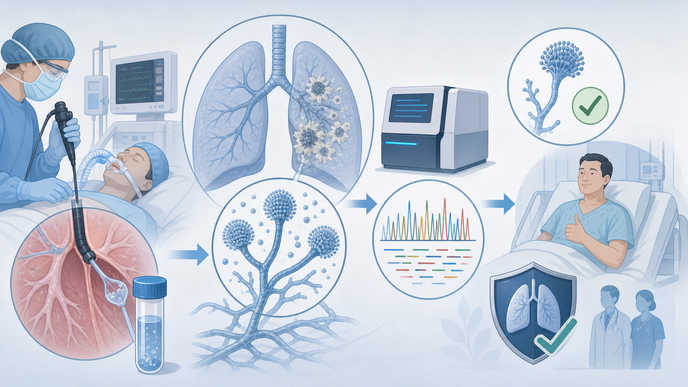
Key Takeaways
- Among clinically diagnosed, antifungal-treated ICU patients with invasive pulmonary aspergillosis in a multicenter Chinese cohort in whom at least one microbiologic test was positive, bronchoalveolar lavage fluid mNGS showed a higher positivity rate than conventional microbiological tests, 96% versus 62%.
- Bronchoalveolar lavage fluid mNGS detected a broader pathogen spectrum and substantially more mixed infections than conventional microbiological tests in both neutropenic and non-neutropenic patients.
- Antifungal management classified as mNGS-guided was associated with lower 28-day mortality than CMT-guided management, 23% versus 44%.
- The apparent clinical advantage was concentrated in neutropenic patients and accompanied by higher rates of appropriate antifungal therapy, while non-neutropenic patients did not show a significant between-strategy difference.
In a multicenter ICU study of BALF mNGS for invasive pulmonary aspergillosis, investigators retrospectively reviewed adults treated across seven hospitals in China from January 2022 through January 2026, enrolling 122 patients and analyzing 114, including 43 with neutropenia and 71 without it. All included patients underwent bronchoalveolar lavage with concurrent BALF submission for mNGS and conventional microbiological tests (CMTs), and antifungal-management groups were classified by which testing modality primarily contributed to treatment initiation or modification. Clinical diagnosis used 2020 European Organization for Research and Treatment of Cancer/Mycoses Study Group Education and Research Consortium (EORTC/MSGERC) host and imaging criteria, but the authors modified the microbiological component by adding BALF mNGS as adjunct microbiological evidence; histopathologic confirmation was not available. Neutropenia was defined as a neutrophil count below 500/mm3 at diagnosis or within the preceding month, and Aspergillus positivity on mNGS required at least 50 unique reads assigned to a single species.
mNGS showed higher overall positivity than conventional testing, but exact agreement between double-positive results was uncommon. When both methods identified organisms, overlap was usually partial rather than complete, suggesting that mNGS and CMTs often captured different additional pathogens rather than the same microbiologic signal. Across both neutropenic and non-neutropenic strata, mNGS more often identified viral, fungal, bacterial, and mixed infections, with common co-detections including Candida species, Pneumocystis jirovecii, Epstein-Barr virus, cytomegalovirus, and herpes simplex virus type 1, while dominant bacterial detections differed by neutrophil status.
Among treated patients, 82 were classified as mNGS-guided and 32 as CMT-guided. In the full report of the multicenter ICU invasive pulmonary aspergillosis mNGS study, mNGS-guided management was independently associated with lower 28-day mortality after adjustment for Sequential Organ Failure Assessment score and neutropenic status (OR 0.329, 95% CI 0.111–0.974; P=0.045). Turnaround time was 32 [23–40] hours with mNGS versus 100 [26–115] hours with conventional testing, and appropriate antifungal therapy was achieved in 65% (56/82) versus 41% (13/32). The mortality and treatment-classification advantage appeared concentrated in neutropenic patients, while non-neutropenic patients did not show a significant between-strategy difference and the temporal sensitivity analysis remained directionally consistent.
Because the study was retrospective and nonrandomized, the mortality findings describe association rather than causation. The authors also noted that IPA was clinically diagnosed without histopathologic confirmation, that allocation to mNGS-guided or CMT-guided management relied on chart review and timing criteria, and that using mNGS as an adjunct microbiological method may have introduced mild selection bias. Colonization or contamination could not be fully excluded, the neutropenic CMT-guided subgroup was very small, and cost-effectiveness was not assessed.
The authors concluded that BALF mNGS offered diagnostic advantages over conventional microbiological testing in ICU adults with clinically diagnosed IPA and that management classified as mNGS-guided was associated with lower 28-day mortality overall. They also reported that the apparent survival signal was concentrated in neutropenic patients and accompanied by higher rates of appropriate antifungal therapy in that subgroup.
Clinician Questions
How was mNGS-guided antifungal therapy defined in ICU patients with invasive pulmonary aspergillosis?
mNGS-guided therapy meant that BALF mNGS findings primarily contributed to antifungal treatment initiation or modification, including escalation, de-escalation, discontinuation, or switching, as documented in the medical record. CMT-guided management meant that conventional microbiological tests plus routine clinical assessment determined therapy and mNGS did not lead to further treatment changes. Investigators also performed a timing-based sensitivity analysis that reclassified cases according to when microbiology results became available relative to treatment modification.
What counted as a positive BALF mNGS result for Aspergillus in clinically diagnosed IPA?
BALF mNGS positivity for invasive pulmonary aspergillosis required at least 50 unique reads assigned to a single Aspergillus species. Samples were centrally processed with standardized sequencing and bioinformatics workflows, and each sample yielded at least 10 million reads. IPA diagnosis still integrated host factors, imaging, microbiological evidence, and clinical response within a 2020 EORTC/MSGERC-based clinical framework rather than histopathologic confirmation.
Which additional pathogens were commonly identified alongside Aspergillus by BALF mNGS in ICU patients with IPA?
The broader BALF mNGS signal extended across viral, fungal, and bacterial co-detections rather than Aspergillus alone. Common additional organisms in the cohort included Candida species, Pneumocystis jirovecii, Epstein-Barr virus, cytomegalovirus, and herpes simplex virus type 1. Bacterial patterns also differed by neutrophil status, with Acinetobacter baumannii, Staphylococcus aureus, and Haemophilus influenzae more prominent in neutropenic patients, and Corynebacterium striatum, Enterococcus faecium, and Klebsiella pneumoniae more frequent in non-neutropenic patients.