
Autonomous Oxygen Titration Improved Normoxemia in SAVE-O2 AI
Key Takeaways
- In acutely ill hospitalized adults receiving supplemental oxygen, autonomous titration produced more time in the SpO2 target range than manual titration.
- Time in hypoxemia was significantly lower with autonomous titration than with manual titration.
- Time in hyperoxoxemia and borderline hypoxemia was also lower with autonomous titration than with manual titration.
- Subgroup findings were described as favoring autonomous titration for time spent in normoxemia and hypoxemia across race and ethnicity, skin-tone categories, oxygen-volume strata, home-oxygen status, admission reason, and pulmonary comorbidity.
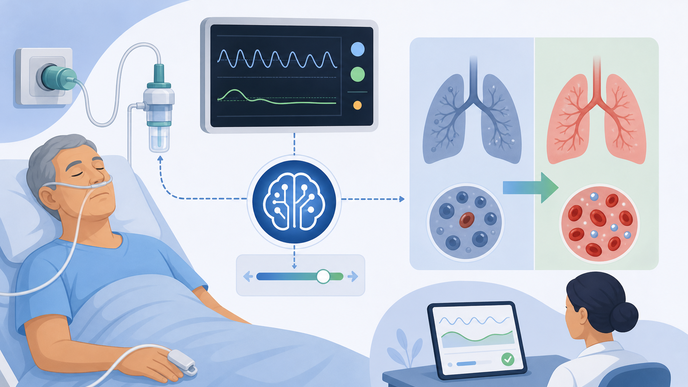
In the multicenter, unblinded, parallel-group randomized SAVE-O2 AI trial in JAMA Internal Medicine, investigators enrolled 300 adults hospitalized for acute respiratory illness, trauma, burn, or acute care surgery who were receiving supplemental oxygen; 152 were assigned to autonomous titration with the O2matic PRO100 and 148 to manual clinician-directed titration. The device was described as continuously monitoring blood oxygen saturation by pulse oximetry and adjusting oxygen flow in real time. The primary assessment was the proportion of time spent within a target peripheral oxygen saturation (SpO2) range of 90% to 96% during the first 72 hours after randomization.
Mean time in normoxemia was 85% with autonomous titration vs 63% with manual titration, with an adjusted risk difference of 21 percentage points (95% CI, 18-25; P < .001). Mean time below 88% was 2% vs 3.6%, with an adjusted risk difference of -1.3 percentage points (95% CI, -2 to -0.5; P = .002). Time above 96% was also lower with autonomous titration, at 9.2% vs 29.1%, and time at 88% to 89% was lower as well. Subgroup analyses were described as favoring autonomous titration for time spent in normoxemia and hypoxemia across race and ethnicity, skin-tone categories, oxygen-volume strata, home-oxygen status, admission reason, and pulmonary comorbidity.
In the SAVE-O2 AI trial reported in JAMA Internal Medicine, autonomous titration improved time in the target saturation range and reduced time outside that range in acutely ill hospitalized adults receiving supplemental oxygen. Over the observed hospital course, short-term clinical outcomes were reported as similar between groups.
Clinician Questions
Which hospitalized adults were included in the SAVE-O2 AI oxygen titration trial?
The trial enrolled 300 adults hospitalized for acute respiratory illness, trauma, burn, or acute care surgery who were receiving supplemental oxygen in acute hospital care.
How was normoxemia defined and measured in the SAVE-O2 AI trial?
Investigators defined normoxemia as the proportion of time spent in a peripheral oxygen saturation range of 90% to 96% during the first 72 hours after randomization.
Did autonomous oxygen titration appear to perform differently across skin-tone categories or other subgroups?
The investigators described the direction of benefit for time in normoxemia and hypoxemia as consistent across race and ethnicity, Monk Skin Tone Scale, Fitzpatrick Skin Type Scale, oxygen volume at randomization, home-oxygen status, admission reason, and pulmonary comorbidity.