
ASTRO Updates Pancreatic Cancer Radiation Guideline
Key Takeaways
- In adults with pancreatic cancer, the updated American Society for Radiation Oncology (ASTRO) framework uses stage-specific radiation guidance across resectable, borderline resectable, locally advanced, recurrent, oligometastatic or oligoprogressive, and palliative settings in a disease with 13% five-year survival and fewer than one in five patients eligible for surgery at diagnosis.
- For borderline resectable disease, preoperative radiation therapy or chemoradiation is recommended to improve local control and increase the likelihood of a margin-negative resection.
- For locally advanced disease, chemoradiation or radiation therapy after multiagent chemotherapy is recommended as definitive treatment, with dose escalation supported when volumetric image guidance and motion management are available.
- Palliative radiation therapy is recommended for bleeding, pain, or obstruction, with dose-escalated approaches described as reasonable for pain relief in selected patients.
- Precision-focused delivery emphasizes intensity modulated radiation therapy (IMRT), daily image guidance, respiratory motion assessment, and adaptive radiation therapy for dose-escalated stereotactic body radiation therapy (SBRT).
The updated Radiation Therapy for Pancreatic Cancer guideline in Practical Radiation Oncology updates ASTRO's 2019 recommendations and was based on a systematic review of research published from 2010 through June 2026. The multidisciplinary task force included radiation, medical, and surgical oncologists, a radiation oncology resident, a medical physicist, and a patient representative, with collaboration from the American Society of Clinical Oncology (ASCO), the European Society for Radiotherapy and Oncology (ESTRO), and the Society of Surgical Oncology (SSO). The guidance spans resectable, borderline resectable, locally advanced, recurrent, limited metastatic, and palliative settings, and it recommends multidisciplinary evaluation and decision-making before and throughout treatment.
For resectable pancreatic cancer, the guideline conditionally recommends chemoradiation before surgery, while noting that preoperative therapy in clearly resectable tumors remains under active study. It also gives a conditional postoperative role to chemoradiation after multiagent chemotherapy when no preoperative radiation therapy was given and lymph nodes are pathologically uninvolved (pN0). In borderline resectable disease, the update recommends preoperative radiation therapy or chemoradiation to improve local control and increase the likelihood of a margin-negative resection.
For locally advanced pancreatic cancer, ASTRO recommends chemoradiation or radiation therapy after multiagent chemotherapy as definitive treatment to improve local control and reduce morbidity from uncontrolled local progression, with dose escalation when volumetric image guidance and motion management are available. In patients with resectable tumors who are medically inoperable or who decline surgery, the same post-chemotherapy approaches are recommended, while radiation therapy or chemoradiation without initial chemotherapy is also described as reasonable for selected patients at higher risk for treatment-related complications or for those declining upfront multiagent chemotherapy. The guidance also identifies isolated locoregional recurrence after surgery without prior radiation therapy as a setting for definitive-intent radiation therapy or chemoradiation, and it describes reirradiation after prior radiation therapy as conditional and dependent on review of earlier plans and dose to nearby normal tissues. It further includes a conditional recommendation for definitive-intent treatment to metastatic lesions and an untreated primary tumor in oligometastatic or oligoprogressive disease, along with palliative radiation therapy for bleeding, pain, or obstruction. When radiation is used before or after surgery or as definitive treatment, nearby areas at risk for microscopic spread should be included, and best-practice delivery emphasizes intensity modulated radiation therapy (IMRT), daily image guidance, patient-specific respiratory motion assessment, and adaptive radiation therapy for dose-escalated stereotactic body radiation therapy (SBRT).
The authors highlight unresolved questions about how best to integrate radiation therapy with evolving systemic treatment, including possible combinations with RAS inhibitors and better selection of patients for more intensive local therapy. ASTRO frames the guidance as support for individualized shared decision-making rather than a substitute for physician and patient judgment.
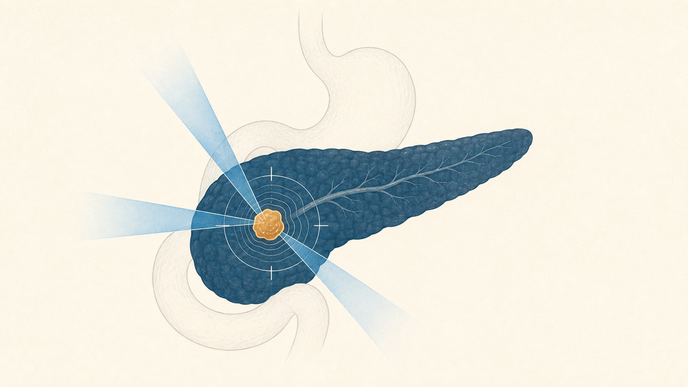
The update frames radiation therapy by disease setting rather than as a single pancreatic cancer strategy. It outlines roles across perioperative, definitive, recurrent, limited metastatic, and palliative care. It also pairs those indications with precision-focused delivery standards for treatment near critical abdominal structures.
Clinician Questions
When does the ASTRO pancreatic cancer guideline describe radiation without initial chemotherapy as reasonable?
In resectable but medically inoperable pancreatic cancer, or when surgery is declined, the guideline describes chemoradiation or radiation therapy after multiagent chemotherapy as the main pathway and also notes that radiation therapy or chemoradiation without initial chemotherapy is reasonable for selected patients at higher risk for treatment-related complications or for those declining upfront multiagent chemotherapy.
How does the ASTRO update frame reirradiation for recurrent pancreatic cancer?
The update separates recurrence by prior radiation exposure: isolated locoregional recurrence after surgery without prior radiation therapy is listed for definitive-intent radiation therapy or chemoradiation, whereas recurrence after earlier radiation therapy is handled as a reirradiation scenario with a conditional recommendation tied to careful review of prior treatment plans and dose to nearby normal tissues.
What technical safeguards accompany dose-escalated pancreatic SBRT in the ASTRO guidance?
For dose-escalated stereotactic body radiation therapy, the guidance links escalation to the availability of volumetric image guidance and motion management and pairs that approach with intensity modulated radiation therapy, daily image guidance, patient-specific respiratory motion assessment, and adaptive radiation therapy to protect nearby organs while maintaining tumor coverage.
What unanswered research question does the ASTRO guideline highlight for pancreatic radiation therapy?
The authors identify an open question around how pancreatic radiation therapy should be integrated with evolving systemic treatment, including whether combinations with RAS inhibitors may have a future role and which patients are most likely to benefit from more intensive local treatment.