
Animal-Contact Enteric Outbreaks Differ by Exposure Type
Key Takeaways
- In U.S. outbreak surveillance from 2013 to 2021, ruminant-associated enteric outbreaks were mainly caused by Cryptosporidium or Shiga toxin-producing Escherichia coli, whereas non-ruminant-associated outbreaks were mainly caused by Salmonella or Campylobacter.
- Overall, ruminant-associated outbreaks were smaller and had lower hospitalization and emergency department visit proportions than non-ruminant-associated outbreaks, but when stratified by etiology, outbreak sizes were similar for Campylobacter, Cryptosporidium, and STEC, and hospitalization and ED-visit differences were not significant.
- Adults aged 20-49 years made up a larger share of illnesses in ruminant-associated outbreaks, while children aged 0-4 years and adults aged 50 years or older made up larger shares in non-ruminant-associated outbreaks.
- Cattle were the dominant implicated ruminant source, backyard poultry led the non-ruminant group, and ruminant-associated outbreaks were all single-state whereas more than half of non-ruminant-associated outbreaks were multistate.
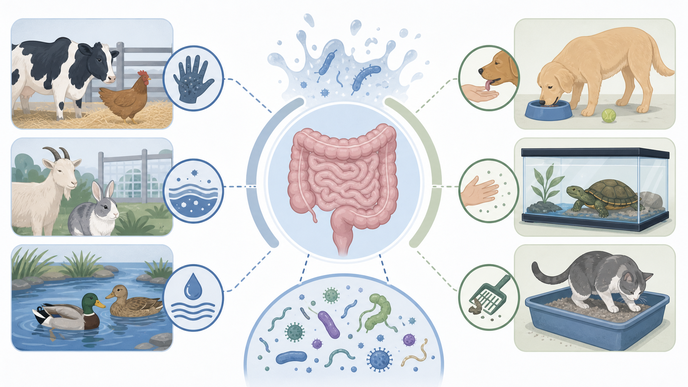
Investigators identified 350 outbreaks and 10,741 outbreak-associated illnesses, including 126 outbreaks (36%) with 1,107 illnesses linked to ruminant contact and 224 outbreaks (64%) with 9,634 illnesses linked to non-ruminant contact. All ruminant-associated outbreaks were single-state, whereas 120 of 224 non-ruminant-associated outbreaks were multistate, with cattle dominating the ruminant group and backyard poultry the non-ruminant group.
Pathogen distributions diverged, with ruminant-associated outbreaks mainly Cryptosporidium 88/126 (70%) and STEC 22/126 (17%), and non-ruminant-associated outbreaks mainly Salmonella 174/224 (78%) and Campylobacter 45/224 (20%). Overall across all included pathogens, ruminant-associated outbreaks were smaller and had lower hospitalization and emergency department visit proportions, but pathogen-stratified analyses showed similar outbreak sizes for Campylobacter, Cryptosporidium, and STEC and no significant within-pathogen differences in hospitalization or ED visits. Adults aged 20-49 years accounted for a larger share of illnesses in ruminant-associated outbreaks, whereas children aged 0-4 years and adults aged 50 years or older accounted for larger shares in non-ruminant-associated outbreaks.
The authors noted that the surveillance system is passive and voluntary, with potential underreporting, misclassification, and jurisdiction-level variation in reporting completeness. Because the data were aggregated at the outbreak level, the analysis could not capture individual exposure details such as handling practices or duration of contact. They also cautioned that direct comparison between exposure groups is limited because all ruminant-associated outbreaks in this dataset were single-state whereas many non-ruminant outbreaks were multistate, so some differences may reflect outbreak structure and surveillance practices as well as epidemiology.
The authors concluded that animal contact type tracked with different pathogen patterns, outbreak size, healthcare utilization, and affected age groups in U.S. surveillance. They framed these distinctions as a practical lens for surveillance and outbreak investigation within a One Health perspective.
Clinician Questions
Which animal exposures were classified as ruminant versus non-ruminant in this U.S. enteric outbreak analysis?
Ruminant-associated outbreaks were linked to cattle, sheep, or goats, while non-ruminant-associated outbreaks were linked to other animal species excluding ruminants. The comparison was based on exposure categories within U.S. outbreak surveillance rather than on individual-level animal-contact histories.
How were cases and outbreak size defined in the NORS and ACOSS comparison of animal-contact enteric outbreaks?
A case was an illness in a person linked to an outbreak by the investigating health agency, and each NORS record represented a single outbreak. Outbreak size was the estimated total number of primary cases per outbreak, including both laboratory-confirmed and probable cases as reported by the investigating agency.
How far do the ruminant versus non-ruminant comparisons extend beyond reported outbreaks?
The analysis was limited to passive, voluntary, outbreak-level surveillance data, so it cannot establish causal mechanisms or capture individual handling practices or exposure duration. Its comparisons are also bounded by outbreak structure, because all ruminant-associated outbreaks in the dataset were single-state while many non-ruminant-associated outbreaks were multistate.