
AI Quality Control Deployment Reshapes Whole-Slide Workflow
Key Takeaways
- Automated QC sat downstream of image acquisition, using a staging area plus PathSync and the enterprise integration engine to route images to acceptance, rescan, or reprocessing under predefined thresholds.
- Feasibility testing covered 60 slides across 3 WSI platforms and showed high cross-scanner reproducibility for tissue fold and air bubble detection.
- During clinical deployment, mean analysis time was 17 s/image, mean total artifact burden was 1.91%, and daily volumes above 6000 slides were accommodated without workflow disruption.
AIRAQc operated downstream of image acquisition through a staging-based architecture that separated scanning from QC review. The PathSync middleware platform mediated communication between AIRAQc and the enterprise integration engine, allowing HL7 release to downstream clinical systems only after QC disposition. Predefined thresholds routed images to accepted, rescan, or reprocess paths, and the system did not modify or overwrite original image data. A phased rollout began on 4 Leica Aperio GT450 scanners and expanded toward 25 scanners after leadership approval, placing the platform inside routine operations.
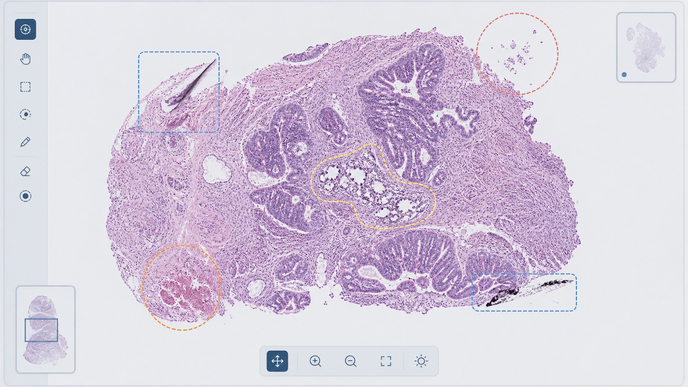
Before deployment, feasibility testing used 60 histopathology slides scanned across 3 WSI platforms. The platform evaluated missing tissue, tissue folds, air bubbles, blurred regions, knife lines, and penmarks or dark spots. Cross-scanner reproducibility was strongest for tissue fold detection above 97% concordance and air bubble detection above 98% concordance. Load testing also included 2500-, 4000-, 10,000-, 17,800-slide, and PathSync backlog simulations, with 0 analysis failures observed. These results supported readiness for live workflow use.
During silent-mode deployment on 4 Leica Aperio GT450 scanners, investigators analyzed 4250 consecutive internally sourced H&E slides across 690 cases without disrupting routine workflow. Among the 9% of cases in which the system identified quality issues, human review confirmed 91%. They also reported significant defects on 8% of slides, primarily blur and missing tissue above the 6% threshold, that routine partial manual technician QC would not have detected. For the month-long operational dataset, 103,094 WSIs were refined to 94,995 analyzable images after exclusions. Automated review supplemented rather than replaced partial manual QC within the reported workflow.
Post-implementation monitoring covered 20 weeks and more than 600,000 slides, with no evidence of performance drift. Mean analysis time during clinical deployment was 17 s/image, mean total artifact burden was 1.91%, and daily volumes exceeding 6000 slides were handled without workflow disruption. Dashboard outputs included scanner-level utilization tracking and technician-specific review metrics, while 17 imaging technicians gave a mean usefulness score of 4.53. All respondents reported increased confidence in image quality assessment, although some longer runs were associated with intermittent network disruptions. The deployment was presented as an implementation and operational evaluation, not an assessment of diagnostic accuracy, downstream error reduction, or patient outcomes.