
ADCY1-Linked Variant Associated With Lithium Response in Bipolar
Key Takeaways
- Among lithium-treated people with bipolar disorder, including University College London recruits, chromosome 7 variant rs116927879 was significantly associated with response, with a consistent effect across cohorts.
- Good-response SNP heritability was 20.3% under a subjective definition and 15.6% under an objective definition.
- Neither genetic correlations nor polygenic risk score associations with schizophrenia or major depressive disorder were detected.
Investigators conducted an observational genome-wide association meta-analysis of lithium response in bipolar disorder. Genome-wide association study (GWAS) data from 1,259 lithium-treated participants recruited at University College London came from three genotyping waves that used different arrays. Investigators analyzed the waves separately before combining their data with two published lithium-response GWAS datasets. Additional analyses estimated single-nucleotide polymorphism (SNP) heritability and genetic correlations with other traits and attempted to replicate previous polygenic risk score (PRS) findings. Participants had previously received lithium; it was not assigned as an experimental intervention.
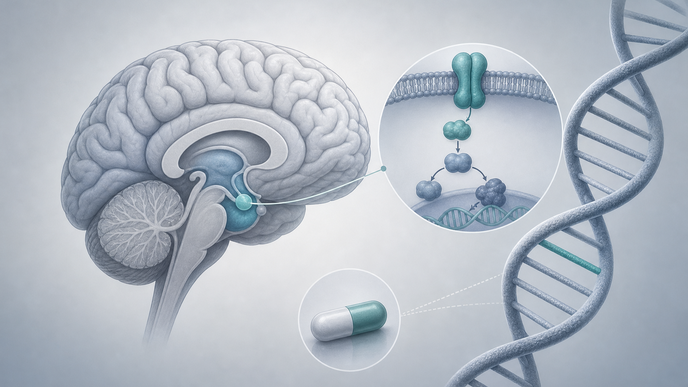
Chromosome 7 variant rs116927879 (A/G) was associated with lithium response at genome-wide significance (p = 4.509 × 10^-8), with a consistent effect across cohorts. It maps to the protein-coding gene ADCY1 and two pseudogenes. Suggestive splicing quantitative trait locus (sQTL) findings indicated that the variant's genotype may influence ADCY1 splicing in different brain regions. This observation concerns a possible biological link, not a demonstrated explanation for the response association.
Estimates of good-response SNP heritability differed according to whether response was defined subjectively or objectively. Investigators also examined genetic correlation with other traits and whether psychiatric-disorder PRS were associated with lithium response. Neither approach detected an association involving schizophrenia or major depressive disorder. Evidence suggesting that males were more likely to be good lithium responders was described as weak.
The response association does not establish ADCY1 as the causal gene, particularly because the variant also maps to pseudogenes. Suggestive evidence of altered splicing likewise does not establish a mechanism for treatment response. Failure to detect genetic correlations or PRS associations with the other psychiatric disorders does not rule out an underlying relationship. These distinctions matter when interpreting the genetic findings beyond the cohorts analyzed.
The authors concluded that the combined GWAS identified a genome-wide significant lithium-response finding and provided updated estimates of SNP heritability for lithium efficacy. The finding remains an association between inherited variation and differences in response among people with bipolar disorder.
Clinician Questions
Can rs116927879 predict whether an individual with bipolar disorder will respond to lithium?
The association across cohorts does not establish validated individual-level predictive accuracy or provide a basis for selecting or changing lithium treatment according to genotype.
Which other genes map to the ADCY1-linked lithium-response variant in bipolar disorder?
In addition to protein-coding ADCY1, rs116927879 maps to the pseudogenes GTF2IP13 and SEPT7P2; mapping does not establish that any of these genes causes differences in lithium response.
This content is intended for healthcare professionals for educational purposes. The article and its image were developed with AI assistance and reviewed by members of the ReachMD team prior to publication. Please refer to the original source linked for the complete and most up-to-date information.