
Transcript
Dr. McDonough:
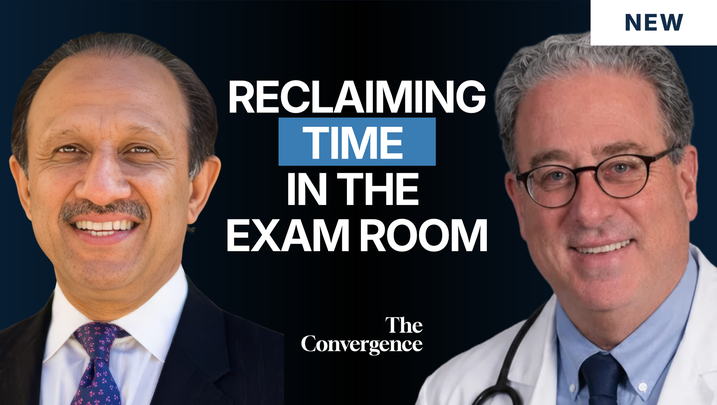
Welcome to The Convergence on ReachMD. I'm Dr. Brian McDonough.
My guest today is Dr. Inderbir Gill. Through his work with USC's AI efforts and OneLine Health, he's exploring how AI can help physicians prepare for the encounter. Today, I want to explore what AI needs to understand about the patient's story and how physicians can evaluate and use that information while keeping clinical judgment in their hands.
Dr. Gill, welcome to The Convergence.
Dr. Gill:
Thank you so much. I really appreciate it.
Dr. McDonough:
Dr. Gill, tell me a little bit about yourself.
Dr. Gill:
At my core, I'm a robotic urologic surgeon. I was born in India. I did my training in the US at the Cleveland Clinic and my residency at the University of Kentucky, and then I was on the faculty at the University of Nebraska, after that, Cleveland Clinic for 12 years, and now, the University of Southern California for the past 16.
And so essentially, what I feel good about is the work that our team has done to advance minimally invasive urologic surgery, specifically initially laparoscopic in Cleveland and then robotic at USC, but laparoscopic, robotic, minimally invasive urologic oncologic surgery. That's been the main thing that we've been really working on developing, helping advance the field, establishing the concepts, generating the necessary data, and then answering the multiple critiques from well-meaning colleagues, because you're trying to do something in a significantly different way than is the norm. And so I think sorting all that out has been a real pleasure, and this is obviously not the work of one person, not just even our team, but our colleagues around the world. So I feel good about where the field is today and the role our team has played in getting it there.
Dr. McDonough:
Fascinating. You and I started out long before AI was even a term or even a dream in anybody's mind, I think. But you're doing your thing, obviously, clearly improving invasive urologic surgery techniques, bladder transplant, and all those things. But you've definitely looked at something and said, “There might be a problem here.” And basically, at the core of what you're doing now, it's about physicians receiving, interpreting, and acting on the amount of information they have in a patient visit, and taking all of these things and making a positive. So tell me about what you're doing and your concept and invention of OneLine Health Technology.
Dr. Gill:
As I start answering that question, let me just state my disclosure. My conflict of interest, OneLine, is a startup that we have built. I'm one of the co-founders, and it's fully disclosed to the University of Southern California.
With that said, overall, innovation is what gets me going in this particular arena where this era of AI is unique and will change civilization and healthcare, and actually do it pretty rapidly. We started at least learning about it, thinking about it, and working on it about four or five years ago when we established the AI center in our Department of Urology at USC and have built a nice, strong team there. This is literally now a daily research interest and endeavor on our part.
At least the way I understand it, contributions in AI can be divided into two different paths. One is developing algorithms, fundamental research, and fundamental capabilities that enable the LLMs and the various capabilities that AI can bring to the table. So that would be basic work that is paradigm shifting and that requires deep expertise in AI, machine learning, engineering and software, et cetera, which clearly, as a physician on my team, we don't have.
The second is the derivatives of that fundamental work. So although you may have an amazing engine, we want it to solve daily tasks. We want it to solve bigger problems that ordinarily will take humans a long time. So we are in the second category, where while we don't have the fundamental engineering and software expertise, what we do have is clinical expertise, clinical understanding, and our understanding of the daily pain points that bring down our efficiency in delivering healthcare.
And so of course, the field is vast. If somebody says, "Hey, what do you do?" And the guy says, “I do medicine," medicine is so vast. We need to narrow this thing down. Similarly, when I say, “We are interested in AI,” what in AI are we interested in? In our neck of the woods, what we feel is daily, repetitive, mundane, scribe-like work is what we would want to automate and enhance.
So we picked trying to improve the efficiencies of the outpatient clinic to streamline and automate outpatient clinics and whatever derives from that. Why did we pick automate? Why did we pick outpatient clinics? Because it is the one ubiquitous task and the one really fundamental fabric on which medicine exists, right? There are 330 million Americans in the country, and there are over one billion outpatient consultations that occur annually. One billion. And improvement in efficiencies, automating, and streamlining some of that could have enormous implications, hopefully positive, on our daily life, not just for physicians, but for patients as well. And since this is what we as physicians live through on a daily basis, we thought this would be a good one to try and tackle.
Bottom line, we have been working on trying to automate and streamline outpatient clinics and whatever derives from it, and a fundamental aspect of the outpatient clinic is the patient-physician encounter, the clinical encounter, and the consultation event that occurs, and that is fundamentally underpinned by creating the clinical note, which is what everything is based on. We have tackled that aspect, and not just us, but many others, of course, to try to automate and streamline that and see how we can improve things.
Dr. McDonough:
That was a great answer because I think it sets up our conversation really well, Dr. Gill. One of the things I love about your background and what you're doing is you're coming at this from a clinical background. You’ve been in the clinic, you're in the exam room, you're writing notes, and you're using the same tools we all used. You're trying to get information from your patients because it'll help you during the surgical procedure because you know so much. Did your thoughts come out of your experience and say, "Wait a minute, there's got to be a better way to do this"? Like, what motivated you to really launch into this? Because a lot of us have these issues, but not a lot of us take it to the next level.
Dr. Gill:
It was fortuitous. It requires somebody not in the system to see the fallacies of the system often, right? If you and I are in it, this is the way we've been trained, and this is the way we've always done it, we will think this is the only way to do it. And it requires somebody from outside the system to be looking in and saying, "Why are you doing it this way?" In this instance, it happened to be my son, who is now a medical student, and this was four or five years ago when he was doing a rotation in cardiology as a research student. He comes to me and says, "I thought medicine was about talking to patients and interacting with them, but what I see with the physicians I'm working with currently is they are on the computer nonstop." That's what they are primarily doing. At least half the day is just entering stuff into the EMR, and even when with the patient, significantly interacting with the computer rather than directly eye to eye with the patient. And he also felt that some of the stuff that we are doing is just repetitive and certainly could be automated, etc. So I obviously laughed it off, “You have no clue what you're talking about,” but I was the guy who didn't have a clue what I was talking about. That's where it started.
And our concept is, why is it that when I see a patient in the clinic exam room, that is the first time I get to learn about why the patient is there? Why can't all this information be gathered for us in a highly sophisticated and detailed and accurate way? Why can't this information be gathered for me upfront and represented to me in advance of the clinical consultation happening? Obviously, it can be easily done wherein we have developed what we feel is an end-to-end AI system that starts from before the clinic visit, carries on during the clinic visit, and then wraps up at the conclusion of the clinic visit. So the way this works is if a patient is coming to see us in clinic, at the time the appointment is made by the patient, we send the patient a link, or an agentic AI call is made, and this link has a humanized avatar that basically contains the knowledge that I would bring to the table, for example. So we have thousands of clinical questions from clinical interactions, clinical consultations, et cetera that we have fed into the computer. We have generated logic tree algorithms—if this, then that kinds of scenarios—and to that fed a bunch of medical literature and knowledge, thereby creating an engine that will truly ask you questions in the same clinical cadence as you and I would ask a patient.
So the next question asked by this humanized avatar is predicated upon the answer to the previous question. If the patient says, "I don't have jaundice," the next question asked by the engine would be down the path of “no jaundice.” If the patient says, "I do have jaundice," the next question would be the path of “yes jaundice.” And this carried to its logical conclusion, will generate a clinical history that rivals or beats what a clinician would do, because clinicians, at the end of the day, are all humans, and therefore have varying levels of skill, talent, and knowledge. And so a good physician would do an excellent history and intake, and a not good physician wouldn’t. Our engine standardizes that, takes it at the highest level, and creates a pre-intake clinic note that then shows up in the electronic medical record in advance.
Then, the patient typically has outside records that I or somebody on my team has to go through to extract the necessary data. Our engine does that too. So once the documents are uploaded, the engine reads the documents and extracts only the relevant information and puts it in the note. So now we have extracted the subjective history from the patient by asking the patient questions directly, and then we have now extracted the objective data from the outside records, relevant data only, and put the two together to construct the clinic note in advance of the clinic visit, all autonomously without any effort on my part. And that note then shows up in the electronic medical record, and that has within it an integrated ambient engine which, when we click the button, ambiently records the entire conversation.
And the conversation now doesn't start from scratch, which is, "Sir, why are you here? How can I help you?" But it starts at a higher level by saying, "I know why you're here. You're here because you've been having shortness of breath, but you haven't had chest pain, and you had some cough or cold." So I am not doing extractive questioning to the patient; I'm doing a confirmatory conversation with the patient, which elevates the floor where we start, and then that entire conversation is ambiently recorded.
And then once completed, it then automatically readjusts the pre-intake note that was autonomously obtained from the patient, thereby finishing the note. And it also gives, if needed, clinical decision support, what could potentially be next steps, and does ICD-11 coding, et cetera, for diagnoses and all. This allows the physician to focus on clinical management planning and clinical medical decision-making. Focus on giving the data that allow us to do that medical decision-making in an automated way. Nothing is completely autonomous. In other words, until the physician reviews it and signs off on it and therefore takes responsibility for it, nothing is activated, et cetera. So that's what we have built so far.
Dr. McDonough:
It leads to so many questions. But first of all, one of the things I saw with OneLine Health is essentially, your goal is to work with the existing EHR information rather than forcing clinicians to reconstruct the patient's story repeatedly, and clearly, you're achieving that goal. Couple questions, though, surrounding it. First of all, when all of this work is done, is there a danger that information could be compressed and maybe something could be omitted? You got all this stuff, but is there something maybe that you may not be able to see because it was already edited out, through AI? Do you worry about that at all, or have you seen that at all?
Dr. Gill:
There is a danger, yes, absolutely. But remember, we are doing just two basic things. Number one, we're talking to the patient and extracting the history from the patient, right? A human could mess that up as well and could forget to ask a patient whether they have gout. "Do you have gout, sir?" or, "How often do you get up at night?" But essentially, we are asking the patient questions in a highly sophisticated way to get their history. So could something be omitted in that autonomous intake? Sure. But also, could a human forget to ask a question? So that part is the subjective history.
Then, extracting from outside records, if you gave me 100 pages of outside records and say, "Here you go, get me the important information from it," I could miss something there, too, right? And I would submit I'd have a higher chance of missing something than an autonomous engine that has been trained on the entire formatting, and it will confirm the name of the patient, the date of the test, and the name of the test, and then scan the document and go to the impression and conclusions and extract that. I would submit that this would actually decrease the chances of an error. I could potentially look at a CAT scan report, I meaning a physician, and get to the conclusion, et cetera, "Okay, this guy has this or that," and completely not focus on, "Hey, this is actually the wrong patient's record." That happens, right?
So your question was, could there be an error? Yes. Have there been errors? Sure. How frequent? Very infrequent. But at the end of the day, that note that is constructed is submitted to me, the physician. It is my job to read it, confirm, and reconfirm with the patient, and only then should I sign off on it. I'm the guy who's taking responsibility for the accuracy of that thing. But if you can take care of all this work for me and now leave me to do an executive function rather than a mundane scribe-like function, it is like if I said to you, "Dr. McDonough, we are going to write a paper on robotic partial nephrectomy. It'll take us six months.” However, if, we said to each other, "Here is the paper that's already written. We need to edit it, and we need to bring our intellectual talents to this, refine it, sophisticate it, and make it real," that's a significantly easier task. So same story here.
Dr. McDonough:
I like the way you explain it. Most people who are thinking about AI documentation are thinking about an ambient scribe. This is much larger than transcription. You’re essentially saying there's a difference between AI saying, "Here's what happened," but it's AI saying, "Here's what you should be thinking about." And that's really what I want to get to with you. Workflow assistance versus clinical decision support. Address how what you're doing takes it to that level.
Dr. Gill:
Correct. So yes, workflow optimization and automating repetitive tasks is what this is fundamentally about. Absolutely. Clinical decision support is already there in our engine and in many others. That’s where compliance kicks in. That's where AI is now suggesting to the physician potential next steps. Even that, though, I think, is kosher. It's okay because it’s just suggesting it to the physician. The physician doesn't have to do it; he can just reject it. But it’s just helping move things along.
So I think as AI engines get better, and as these AI chatbots get better, they are doing autonomous clinical decision support. Patients today are actually reaching out to some of these engines that are out there and asking them questions: "Hey, I have a cough. I have a headache. What should I do?" And so this autonomous medical decision-making and support is already out there, and I think will increasingly be commonplace. So this is a rapidly advancing field, and we have built something that is HIPAA compliant, all patient privacy, et cetera, fully protected, and vetted by institutions and by EMRs.
So I think that this is the way the future is headed—forget the future, where the current is headed. The single most, to my knowledge, at least, hottest trend in 2024 even, and certainly 2025, was the ambient revolution in healthcare. This is the fastest growing thing in healthcare in the past year or so. And I think what our team has done is taken it to the next level, because in the ambient enterprise, if you and I are having the consultation and we switch on the ambient engine, it will faithfully record everything that you and I spoke.
Dr. McDonough:
In a OneLine case study, you had described its use at USC. So you're using it in the real world for visit preparation and documentation and reported physician time savings of approximately 1.9 hours per clinic day. That's huge. Is that something that you continue to see? And are the physicians you're working with excited about it? Are they pushing back? How are they using it?
Dr. Gill:
The 1.9 hours is retrospective data in a smaller cohort of interactions. We have not published this; it's retrospective data. We feel that is about the accurate number, and we feel that we would be saving between 5 to 10 minutes per patient encounter and decrease all the mental work that goes in those 5 to 10 minutes. We are now in the process of starting a prospective randomized comparison with IRB approval looking at this technology.
How are physicians using it? They are using it as we intend them to use it, which is their team sends out the electronic link to the patient, the patient at home fills out the answers to the questions, and the notes are generated in advance. We call it the pre-intake. And then sitting on top of that is the ambient capability that then captures the conversation and readjusts the pre-intake note to create the final note, all without the physician ever hitting a keystroke on the computer.
Dr. McDonough:
Yeah, I was going to say there's so many ways to save time. There's chart review, documentation, clicks, and work after the clinic. Is it a combination that saves the time, or is there something that really jumps out at you as the real big time-saver?
Dr. Gill:
The combination. All of the above. You talked about work outside work; that's the bane of our existence. Finishing in the clinic doesn't mean finishing our work. We still have to do another two hours of stuff either in the evening or over the weekend, and that piles up, and that's the primary cause for burnout amongst physicians. So yes, we want to get to a state, and we think we already are there, where the moment I walk out of the clinic consultation room, that note is done and no further work needed to eliminate work outside work before and after clinic—not just minimize, but eliminate it. So that is, we feel, a huge game changer.
Dr. McDonough:
And again, because you have a real-world laboratory and you're studying it, I’ve got to ask you this question because I'm just curious. How do you measure whether an AI system is improving care rather than simply making the physician faster? Is there a way to check that?
Dr. Gill:
Yes. In this prospective comparison that we are going to be embarking on here in short order, the primary endpoint is Total Clinical Work Time, or TCWT. From the start of that patient's medical journey encounter until the end, the total time used by the physician for the consultation, encounter, before, during, and after is the primary indicator. The second one is the quality of the clinical note, so comparing only ambient capability versus the full stack, end-to-end capability that we have built to see the quality of the clinical note. Third is physician satisfaction and physician burnout, and there are various survey instruments, such as the NASA-TLX, the Stanford survey, et cetera. So that assesses physician satisfaction. Then patient satisfaction, which is the Press Ganey survey.
In addition to the construction of the clinical note, et cetera, we're also talking about automating the orders. Now, if I want to get a CAT scan and a CBC and CMP and blood test, I have to now go into a different field and start clicking again to put in that order. Once we say during our consultation we want a urinalysis, a blood test, CBC, CMP, CT scan, and ultrasound, for example, automatically, our engine will go check off those boxes on the order side of the equation in that EMR, in the Veradigm EMR in this instance, to automate those orders. Those are enormous time savings because the ordering of the test for a patient is, “Okay, order the test, what's the big deal?” If you're doing it 50, 60 times a day, that'll drag you down.
Dr. McDonough:
Oh, there's so many things like adding codes and all the different things that go into it. Let me ask you, on a prior episode of The Convergence, I had a guest, and one of the fears was you're going to see incredible success rates, but because many of these models are built to please someone, you may get at the very end the toughest diagnosis, and that's the one after you trusted that could be missed. And as a clinician, you're going, "Oh, I didn't think of that. I guess AI's right," and that could be where it's wrong because it wants to come up with something. Let's say 99 times out of 100 everything's going well. Is that 100th episode, that one error, harder for you to catch when you're reviewing things because it's been so darn reliable before? Is that something built into it that concerns you?
Dr. Gill:
I just want to make sure I understand your question correctly. So you were saying that in the clinical decision support scenario, if the engine is suggesting various differential diagnoses, and in that list, at the bottom would be a rare entity, is that a good thing or a bad thing? Is that the question?
Dr. McDonough:
It might be coming up with something that could even be wrong because it wants to be right. It has to come up with an answer. Whereas the strength I've always felt as a physician is the longer I practice, I'm always questioning, what didn't I think of? Am I wrong? I don't know if AI works that way. It wants to be right and thinks it's right, and that's a fear. Do you see that as a concern in your workflow?
Dr. Gill:
Good point. Listen, human in the loop is fundamental, okay? Human in the loop is fundamental. And as a physician, as a clinician, I would actually value that rare diagnosis being brought to my attention because for sure I would not have thought of it. Talking in generic terms, a physician may not have thought of it. Once it’s brought to my attention, I can immediately discard it, reject it, and not hurt the patient or the process. Until I click to say I have read all the above and acknowledge it to be true and I certify it, nothing is active. In your question, if the critique of AI is it may suggest things that are inaccurate or not relevant, it would certainly be annoying. It'll certainly be annoying to me. But at least it brought it to my consciousness that, okay, it could be the Birt-Hogg-Dubé syndrome. I wouldn't have thought of it otherwise.
Dr. McDonough:
And if it doesn't apply and it doesn't fit, you reject it. So I don't see that as a negative, per se. I think your message is right, by the way, clinically, but I'm getting a strong message that ultimately, all these things are tools, all these things help us, but it still comes down to the physician owning it, taking responsibility, and reviewing it.
And so let me take this now. I work at a healthcare organization. Many of us do. And not saying they're good or bad, but a lot of administrators are looking at dollars and cents, and they're looking at maybe these tools as let's increase productivity because we're saving time, and then there's RVUs, and there's payment models, then there's all these things, forcing the physician to get things done and move on. And there's also the desire not to have pajama time, all these things. We still have an issue where, will they be told you are to see more people in less time because we can even make more money? And how do you fight that? Because that could be an unintended consequence of what you built.
Dr. Gill:
Very good question. And we live in an imperfect world. That's not news to anybody. There are enormous pressures on hospital systems, on administrators, and on physicians. Enormous pressures. Some of our administrators say, "No money, no mission," et cetera. The physicians, could they be asked by the administration to see more patients now that we have taken away the mundane part of your task and we've saved you, in this instance, let's say five to 10 minutes per consultation? And you add it up during the day, that actually saved one to two hours per clinic, okay? You have two choices. You can go and play golf. Totally fine, okay? Or you can see three or four more patients. So that is the physician's call, or more likely the hospital administrator's call. One or the other. If you're in private practice, what would you do? You and I are in private practice together. We finished our clinic, let's say, two hours early. What are you and I going to do? Are we going to see a few more patients? Are we going to just say, "Done, I'm going to go play golf"? Either is fine. It's up to us.
And so I won't say anything more in this regard other than to say that. If we can free up time and maintain the mental equanimity and freshness of the physician's brain and make the physician restore the joy of medicine rather than being in that continuous wheel, how we choose to use that time at the end of the day is our call.
Dr. McDonough:
And again, it comes down to the physician making that decision and determining it with control. Again, AI and what you've developed has provided more time, but now how do you want to use it? I’ve got to ask you another question. You're obviously a critical thinker. You spent your career looking at things and finding different and better ways to do it and taking on new things. What are you skeptical about with all of this? You now have your audience, they're listening. What should a physician be skeptical about? Nothing's perfect, like you said, so what could make it more perfect? Or what bothers you about it?
Dr. Gill:
I think that, as physicians, we are used to critical thinking. We've been working hard all our lives, not just in med school, but prior to getting into med school, burning the midnight oil and really making sure that we are good at what we do. With that background, we're performing at the highest level, and we're moving along in life, et cetera. We are therefore confident and comfortable in what we do and feel that we do a good job.
The hardest thing to change is human behavior. It's easy to come up with an idea, to build something, and to make sure it works, but then to have it actually deployed and have physicians actually take to it is the challenge. I personally feel it is inevitable. We, you and I, can resist it for X amount of time. It is like saying, “Hey, you have a car standing in the garage. Excellent. But you still want to walk to work. Knock yourself out.” I think we are already seeing that as we deploy this engine on a daily basis in our clinician's life, now they are saying, "Oh, obviously this is the way to go." So it is just getting over that initial hump, and some physicians have even said that in a paper published recently by another team, the question was to the physicians, “What if tomorrow we took away this capability that we've given you that study?" Meaning the ambient technology. They said, "We'll consider quitting and going to another place."
Dr. McDonough:
One final question I just got to ask you on a personal level. Clearly, you've spent your career choosing projects where outcomes aren't guaranteed. It can be robotic surgery, transplantation, AI, all of those things. Do you do this because it's a challenge? Do you do it because it's fun? What motivates you and what made you continue, I would say, to push the envelope?
Dr. Gill:
Thank you for your kind words. Brian, for the entire past 35 years, I have been single-mindedly focused on surgical innovation, on taking operations and making them better in reducing the complications, increasing the sophistication, improving the outcomes, et cetera. And with God's grace, our team has, along with our colleagues around the country and around the world, achieved that. We have moved the needle to robotic surgery for a good 90 percent of major urologic surgeries. Think about that. And we've pulled this off in a decade and a half.
I can't shake the feeling, more so in the past five or six years, that at the end of the day, when I'm doing a surgical case, I'm helping one patient at a time. Now clearly, by training fellows and residents and doing all these conferences and training urologists from around the world, hopefully we've impacted the practice of many physicians. But at least on a personal level, I'm taking care of one patient at a time. With AI, with this capability, the potential exists to fundamentally change how medicine is practiced and to impact hundreds of thousands in one go. So that is very exciting and personally is one of our daily chores at this point.
Dr. McDonough:
Dr. Inderbir Gill, I want to thank you for joining me on The Convergence. It's really been a pleasure chatting with you. I really appreciate you taking the time.
Dr. Gill:
Thank you so very much. I appreciate this opportunity. And I think that with change comes new responsibilities, and I think the coming era is coming at us at breakneck speed, by the way, so heads up. But the coming era is hugely exciting, and we would be remiss not to try and use it to our benefit.
Dr. McDonough:
You've been listening to The Convergence on ReachMD, where innovators and physicians explore the technology transforming medicine. To hear about other technological advances shaping the future of healthcare, visit The Convergence on ReachMD.com, where you can Be Part of the Knowledge. Thanks for listening, and we'll see you next time.