
Transcript
Announcer:
You're listening to Project Oncology on ReachMD. This episode is sponsored by Bristol Myers Squibb. This is a non-certified educational series produced and controlled by ReachMD. And now, here’s your host, Dr. Alexandria May.
Dr. May:
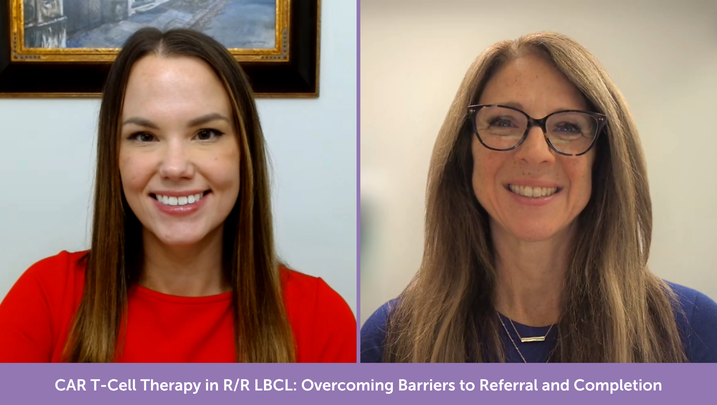
This is Project Oncology on ReachMD. I'm Dr. Alexandria May, and today I'm joined by Dr. Tara Graff, a medical oncologist and the Director of Clinical Research for Mission Cancer + Blood at the University of Iowa. Together, we'll be reviewing expert panel findings and recommendations on overcoming barriers to referral and completion of CAR T-cell therapy for relapsed or refractory large B-cell lymphoma, which were published in Transplantation and Cellular Therapy.
Dr. Graff, thanks so much for being here today.
Dr. Graff:
Thanks for having me.
Dr. May:
To start with some context, this paper builds on survey data suggesting that 63 percent of eligible patients aren't referred to an activated-authorized treatment center for CAR T-cell therapy, and only 16 percent ultimately receive it. What did you and the other panelists hope to better understand about the gaps between eligibility, referral, and treatment?
Dr. Graff:
There's a few things going on with this, because you see this large number of patients who are not receiving it or not even being referred, but even of those patients who are being referred, a very small percentage is actually receiving therapy.
So the first bucket is where the patients live. They're at home in their community oncology practice, and they've relapsed. One, you need to have a clinician who is aware of the data, aware of the treatment landscape, and aware that CAR T in the second line could be a game changer and lifesaver for a patient. But if you don't keep up when you're seeing all these other cancers, it's hard to realize that.
The other question I always have is, who's determining if that patient is actually eligible? So the primary oncologist might think, "Oh no, they're too old," or "They're too this," or "They're too that," and they'll think they're not eligible, and they'll make that decision before we even really know if the patient is truly eligible.
And sometimes it's patients, right? Sometimes the patient doesn't want to travel. They are the primary caregiver of their spouse, a child, or somebody else, or logistically, in terms of transportation and money, there's so many different barriers, right? So those are the ones that happen at home.
But then, for those patients who do get referred, an even smaller amount actually receive therapy. So what's happening there? Is the patient afraid to be away from their primary oncologist? Is the time spent away too long? Could they not take time off of work? What does this look like?
So it's not just one thing. What is happening at each spot along the way where this number is just dismal, right? We need to do better, and so that's what this paper is about. It's an eye-opening piece of, what is happening? What are the barriers? And what can we overcome together?
Dr. May:
The panel estimated that 40 to 50 percent of patients may remain unaware that CAR T-cell therapy is an option until later in their disease course. Why do you think those conversations are delayed, and when should clinicians begin discussing CAR T-cell therapy with potentially eligible patients?
Dr. Graff:
I have patients who will walk in day one newly diagnosed and ask me when they're getting their CAR T-cell therapy, and I say, "Well, hopefully you don't need CAR T. But if you do, we will discuss it at a later date.” But then you have other patients who really just do what their doctor says. They're not on all of the different websites. They don't have their kids barking in their ears. And so for them, they don't know; they're just following the lead of what they're being told. So that's hard, right?
I always think it's better when patients have some education around what's going on and have read, but that's a slippery slope, because sometimes the information they're reading is not very accurate either. But what I would say is if you have a patient with large cell lymphoma who has relapsed, I think, as a clinician, it is very important to phone a friend immediately. You don't necessarily have to send your patient out. You're not going to lose your patient, but just call somebody. The phone-a-friend doesn't even have to be a large academic physician. It could be somebody you know in the community who specializes in large cell lymphoma or who has a lot of experience with CAR T, but just somebody to whom you can say, "Hey, I have this patient. This is what I'm thinking about doing. Do you think I need to send them for a CAR T evaluation?"
I think you owe it to the patient to make sure the expert in the field is making the decision if they are CAR T eligible or not, and then the decision made by the patient is on them, right? That's completely up to them, but at least we’re affording them the ability to make a good, sound decision based on all the information.
Dr. May:
There can also be uncertainty about who should be considered for CAR T-cell therapy, particularly when age and comorbidities are a concern. The paper notes that clinicians may sometimes apply more restrictive transplant eligibility criteria to CAR T-cell therapy. How can that affect referral decisions, and what should community oncologists keep in mind when deciding whether to refer a patient for evaluation?
Dr. Graff:
I think what happens is a lot of community physicians remember transplant like, "Oh, this person's too old to send to transplant." But CAR T is very different. I mean, if someone's 95 and in a wheelchair on oxygen, maybe you're not going to do a CAR T. But just because you're 85 years old doesn't mean you can't have CAR T, right? So I think that's the problem. We have this misnomer in our head based on what the guidelines are for transplant, and they're not the same, and so I think that's the problem. We need to let the physicians who are used to making that decision on CAR T eligibility make the decision, not the primary oncologist.
Now, again, I want to be clear, because there are some primary oncologists who are very good at referring patients for CAR T, and they know exactly what to do, and that's not what we're talking about. We're talking about physicians who may not know the latest guidelines, may have these concerns, and may have these assumptions, and that's where we have to target. How do we pair that oncologist with somebody who can help them kind of weed through, "Hey, is this patient a CAR T candidate or not?"
Dr. May:
Now, the paper's core message for community oncologists is that potentially eligible patients should, at minimum, be referred for consideration. So in practice, what does an effective referral process between the oncologist and the CAR T center look like?
Dr. Graff:
There really needs to be some type of phone-a-friend system where you can pick up a call, text, or email, and say, "Hey, Dr. Smith, I have this patient. I think they might be a CAR T candidate. I'm not sure. They're kind of leery about having to drive two or three hours to come meet you. Can we set up a time for us to talk? Can you potentially do a telehealth meeting with them?" That can be done. That is being done, and we need to utilize those communication highways, I think, a little bit better, because one, you can learn a lot from a quick conversation with a colleague. Is this patient eligible? Here's everything going on, yay or nay. If it's yay, then “Hey, this patient doesn't want to drive until they hear more. Can you set up a call?” And we're in the day and age where that can be done very simply. And so I think we need to utilize some of those resources a little bit more, because then patients will be a little bit more on board with everything going on.
Dr. May:
For those just joining us, this is Project Oncology on ReachMD. I'm Dr. Alexandria May, and I'm speaking with Dr. Tara Graff about expert panel recommendations for addressing barriers to CAR T-cell therapy for patients with relapsed or refractory large B-cell lymphoma.
So Dr. Graff, we know that referral is only one part of the challenge. Cost, travel, and caregiver needs can also make it different for patients to actively move forward with, with treatment. The panel recommended bringing social work, financial counseling, and patient navigation into community practices earlier in the process. How could earlier access to those resources affect a patient's ability to complete the CAR T-cell therapy pathway?
Dr. Graff:
Depending on the size of the community oncology practice, they don't have their own social workers and clinical coordinators. It’s not a transplant center that has multiple nurse navigators and multiple social workers, right? And so I want to say patient advocacy groups are actually underutilized. We know that there are a lot of resources out there that we don't even realize. I learn things all the time when I go to different summits and meetings where I'm asked to sit on panels and I sit with somebody who is part of this CAR T alliance or that. I'm like, "Wow. That’s a great resource. What's your website?" And so I always tell these advocacy groups, "Get your information out there," because it's a lifeline, sometimes just helping with gas cards and things like that.
I will say, too, a lot of the pharma companies that have these CAR T products also have programs where they will help with gas cards and transportation. We don't utilize the patient access and patient resources enough with the pharma companies, but they do exist.
And I almost wish there was a shared system. So I wish for some parts of the country where the academic-community partnership is a little stronger and a little bit more fluid, I almost wish there was some way to share, so that you could not just refer the patient to the physician, but also say, "Hey, can we use some of your resources?" Because you're going to need them anyhow. If the patient's going to get CAR T at center X, you're going to need these people. So is there some way that we could sort of share resources in those cases?
Dr. May:
And that partnership with the treatment center doesn't end once the patient receives CAR T-cell therapy. As patients transition back to community care, what information, monitoring guidance, and communication from the CAR T center are most important for safe long-term follow-up?
Dr. Graff:
I always say it's a back-and-forth communication highway. It's so important that the referring physician provides all the information to the site that's going to be reviewing the patient for possible CAR T. Well, that relationship has to also come back. It is so important that the physician or the team taking over the patient, especially if they're doing an earlier return, which we do because we manage so many other cellular therapy toxicities and things, has the communication of what happened. One, what did they receive? But also, what occurred? Did they have CRS? Did they have neurotoxicity? What was the intervention? Did they have kidney issues? Do they require transfusions? All the things so that you are prepared to make sure you're seeing them frequently and to make sure that you know they need to be seen once a week, once every other week, or whatever that monitoring period looks like, and also to know what you have to watch for.
It’s kind of like when mom and dad go out at night and you give your baby to the babysitter. You need to let them know, “They ate this time, they went to the bathroom this time, and here's what I'm expecting. If this happens, please do this.” So it's very important, and it's very important to have communication set up in terms of how to reach the CAR T center once the patient's back locally. What would be a reason to transfer the patient back? I mean, we don't have to do that hardly at all, but what would occur? What does that look like? Because I think, again, you leave the numbers for the fire department and the police department on your fridge when you go out and the babysitter's there. Same thing: you just want to be able to have the information that you need should you need it. You hope you never do, but I think it's really important that the communication forward and back is respectful of one another because it's the patient you’re really concerned about at the end of the day.
Dr. May:
Finally, Dr. Graff, one of the panel's two prioritized initiatives was expanding the network of sites capable of delivering CAR T-cell therapy in community settings. What would need to be in place for the expansion to reduce access barriers while maintaining the safety and quality expected at experienced CAR T-cell centers?
Dr. Graff:
We know there are far too many people who need CAR T and not enough places to get it, and so a number of us are working on getting CAR T into the community.
Now, with infrastructure, the most important thing, and I say this even when I talk about bispecifics, is that you have to have a team. You have to have a dedicated team of individuals, a physician champion, which is myself here, and then APPs and nurses. Now, the number will vary depending on the site and the size and things like that, but you have to have a team that is dedicated, passionate, and really willing to sacrifice their time to take care of these patients, in terms of setting up education and writing SOPs and coming in in the middle of the night if you need to for evaluation and things like that. So a team is key. Nothing else matters without a great team.
But then you need to have a concise plan, and then on top of that plan, part of that plan is an escalation pathway. What happens at two o'clock in the morning when the patient calls in with X, Y, and Z? What are you going to do? What is your alarm sound? What happens? So I think those are all important in the infrastructure, if you will, which can be done. A lot of these sites are doing bispecifics. I mean, the volume is very high, so CAR T can be done. The infrastructure exists.
So I think within the next few years, I think we will see more sites. But the thing is, we have to see more sites. We need to have more sites, and that's the bottom line.
Dr. May:
Well, that's a great comment for us to think on as we come to the end of today's program. I want to thank my guest, Dr. Tara Graff, for joining me to discuss how we can address barriers in CAR T-cell therapy in relapsed or refractory large B-cell lymphoma. Dr. Graff, it was great having you on the program.
Dr. Graff:
Thanks for having me.
Announcer:
This episode of Project Oncology was sponsored by Bristol Myers Squibb. To access this and other episodes in our series, visit Project Oncology on ReachMD.com, where you can Be Part of the Knowledge. Thanks for listening!